
Last updated: 9 September 2026
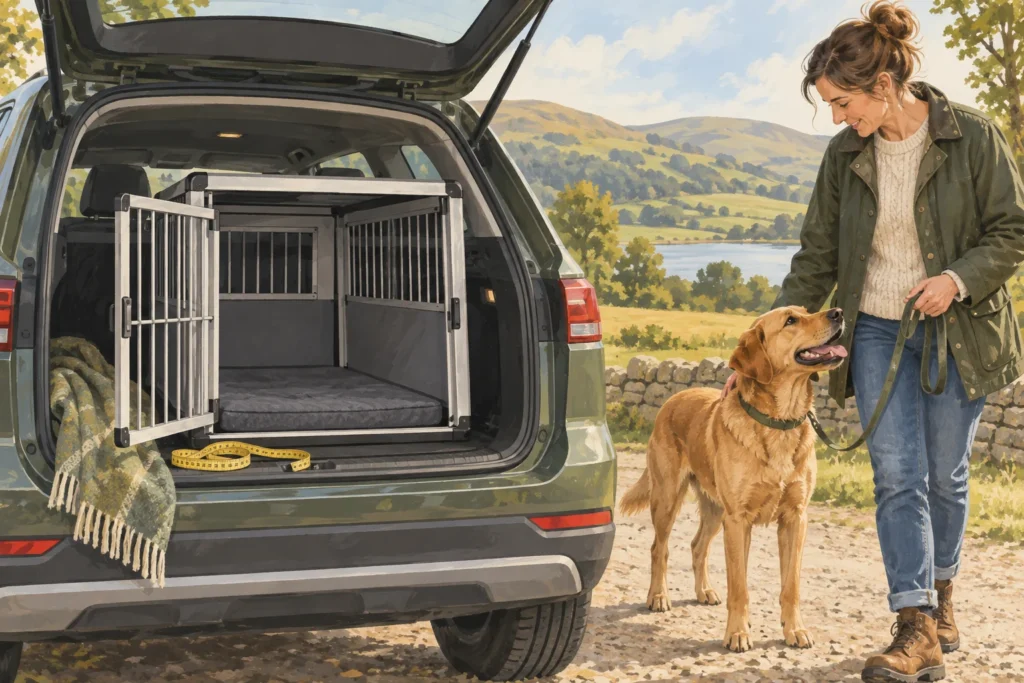
The best dog crate for a car boot is a transport model that fits your dog’s natural posture and your vehicle’s usable space, with clear fixing instructions. Start with those requirements before choosing a familiar size label. “Medium” is a product name, not a measurement shared by all crate brands.
For UK buyers, the Thule Allax range is one useful place to begin a specification comparison because Thule publishes vehicle-fit tools, dimensions and testing information. It is not automatically the correct crate for your dog or car, and a more expensive model cannot compensate for insufficient room.
Table of Contents
Measure the dog while standing naturally
The RSPCA advises that transport accommodation should allow a dog to stand, sit, turn and lie in a natural position. Measure your dog without encouraging a crouch or curled posture to fit a smaller box. Use the crate manufacturer’s sizing method, then check the resulting interior rather than relying on a weight limit alone.
A tall, light dog can need a different crate from a shorter, heavier dog. Thick bedding also changes usable height. If the dog cannot comfortably occupy the suitable vehicle space, reconsider the restraint arrangement rather than removing essential room.
Our dog travel crate size guide explains the underlying measurements. This buying decision adds the car’s shape, installation requirements and day-to-day access.
The boot floor is only one measurement
| Measure or inspect | Why it matters |
|---|---|
| Opening width and height | The assembled crate has to pass through the tailgate opening |
| Width between wheel arches | The usable floor can be narrower than the boot’s widest point |
| Depth at floor and roof height | A sloping seatback or rear window reduces upper clearance |
| Loading lip and crate door swing | A door may hit the vehicle even when the crate body fits |
| Fixing points and prescribed clearance | Installation must follow the specific model instructions |
| Access with luggage loaded | The dog and any escape opening still need to be reachable |
Make a cardboard profile matching the crate’s external dimensions, including its upper slope where relevant. It is a useful early rejection test, though it cannot prove correct installation. A model listed as compatible may still require a particular boot-floor setting or seat position.
Thule Allax: what the published specification offers
Thule’s UK Allax S page gives external dimensions of 55cm wide, 58cm high and an adjustable depth of 72–80cm. It lists a crate weight of 17.7kg. Those figures show why both installation and handling deserve attention: even a smaller transport crate is a substantial object to lift out regularly.
Thule describes crash testing and TÜV SÜD certification, adjustable depth and an escape hatch accessible from the rear-seat side. Treat those as reasons to inspect the current instructions and certificate, not as a guarantee against injury. The feature only helps if the installation leaves the required access available.
This article contains Amazon affiliate links. As an Amazon Associate, we earn from qualifying purchases.
Find Thule Allax S dog car crate on Amazon UK. Compare the exact size code and generation with Thule’s fit guidance; do not assume a seller’s “small” description identifies the same product. Other Allax sizes have different dimensions and weights.
What to ask when comparing another transport crate
Request the installation manual before buying. It should make the intended vehicle position and fixing method understandable. Ask for evidence behind specific crash claims, including the tested size and setup. A substantial-looking metal frame and a “heavy duty” label do not answer those questions.
Look at the latch and the way the door opens, especially if you have limited grip or need to manage a lead at the same time. Check whether cleaning requires removing the crate, what replacement parts are available and how the seller handles a fit problem after assembly.
A folding domestic wire crate can be convenient at home, but convenience does not establish performance as vehicle equipment. Buy for the use the manufacturer actually supports.
Do a parked-car rehearsal before travelling
- Install the crate exactly as directed, then check it with the boot at its normal loaded configuration.
- Confirm the main door and any emergency access operate without moving luggage.
- Introduce the dog calmly, allowing investigation and short comfortable sessions.
- Practise clipping on the lead before opening the exit fully in a secure setting.
- Inspect fixings and condition as part of the normal pre-journey routine.
Use our crate training guide for gradual introduction. A transport crate should become familiar before it is associated with a long, busy journey.
The successful purchase is a crate that still works when the car is packed, the dog is tired and you need to stop somewhere unfamiliar. Leave those practical checks until delivery and a cheap-looking offer can become an expensive return.