
Last updated: 9 September 2026
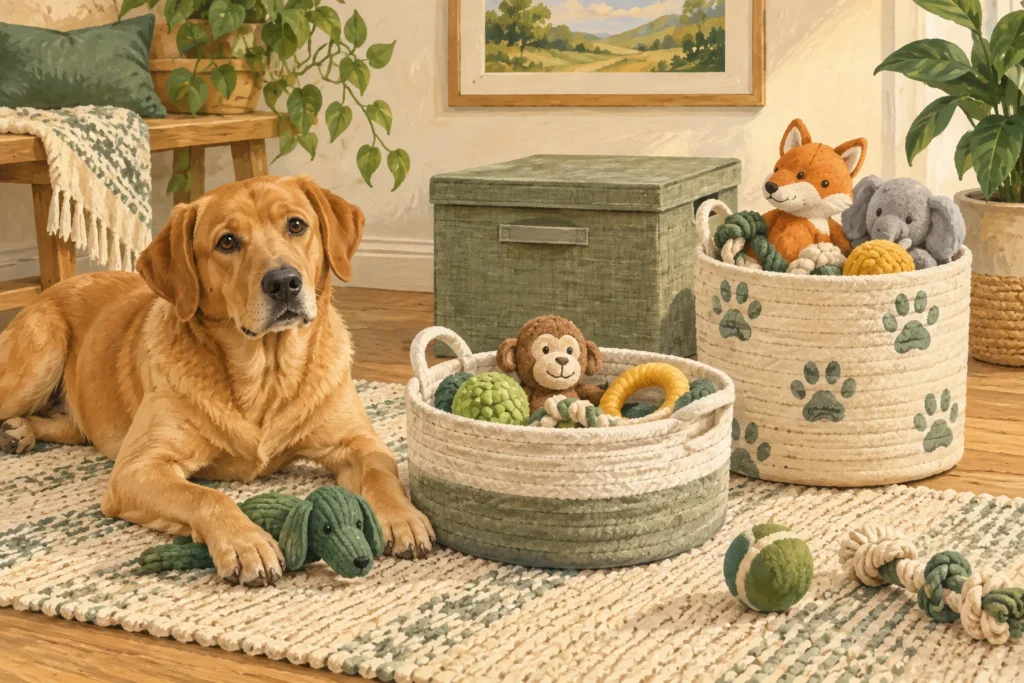
For most homes, useful dog toy storage means a small accessible container for appropriate everyday toys and a separate place for items that need supervision. Choose by cleaning, height and safe edges before appearance. A basket that looks tidy but is difficult to wash or invites chewing creates extra work.
You may already own a suitable container. Measure the collection and its intended location before buying a large personalised toy chest. The best setup is the smallest one that keeps clean toys organised without making every item available to the dog all the time.
Table of Contents
Decide who should be able to reach the toys
An open low-sided box can let a dog choose from a few suitable toys. A lidded box on a shelf can hold spare toys and equipment brought out by a person. These are different jobs, so one large container is not always the most practical answer.
Follow the toys’ individual supervision instructions. Tug ropes, small training components and food toys may need to be put away after use. A lid at floor level is not a reliable barrier for a dog that opens or chews containers.
Think about the rest of the household too. Put storage where nobody trips over it or has to reach across a resting dog. In a multi-dog home, consider whether an open shared basket could create tension over possessions and seek help if guarding occurs.
Compare three storage formats
| Format | Useful role | Main limitation |
|---|---|---|
| Shallow rigid box | A small selection of dry toys with easy visibility | Inspect edges and choose a comfortable access height |
| Washable fabric basket | Lightweight storage for suitable dry toys | Handles, seams and internal stiffeners may invite chewing |
| Lidded shelf box | Spare or supervision-only equipment stored by people | Must stay inaccessible; not a toy-access container |
Wicker, decorative rope and wooden chests deserve close inspection if the dog can reach them. Consider splinters, loose strands, hinges and swallowable decorations. A paw-print label does not establish that the container is appropriate for chewing or unsupervised contact.
A shallow box: check internal dimensions
The Really Useful 10.25-litre quality nestable box is an example of ordinary household storage with published measurements. The maker lists approximate internal dimensions of 335 × 210 × 140mm and external dimensions of 405 × 265 × 160mm. It includes a lid and is sold singly, even when photographs show multiple boxes.
This article contains Amazon affiliate links. As an Amazon Associate, we earn from qualifying purchases.
Find Really Useful 10.25-litre nestable storage boxes on Amazon UK if those dimensions fit your spare-toy storage. This is a household box, not a product certified for dog access. Use it for organised storage under your control and assess edges, condition and placement before bringing it into the dog’s area.
The internal footprint matters more than the litre number when storing a wide disc or long tug toy. The external dimensions matter for a cupboard. Measure the awkward items first so you do not discover that the capacity figure hides an unsuitable shape.
A fabric basket: verify what “washable” means
Look for explicit care instructions. Some baskets can be machine washed; others only allow wiping or spot cleaning. A removable liner may be convenient, provided the dog cannot pull out and chew it. Check drying requirements and whether washing changes the basket’s structure.
Find washable fabric dog toy baskets on Amazon UK if a soft basket suits the room. Choose simple construction, a suitable opening and handles that will not tempt your dog to carry the whole basket away. Verify the care label of the specific listing rather than relying on the search term.
Avoid selecting a very deep basket just because it holds more. Small or less mobile dogs may struggle to reach the bottom comfortably. Keep the everyday selection shallow enough to see, and store the rest elsewhere instead of encouraging rummaging through a tower of toys.
Keep food toys out of the clean collection until washed
Remove leftover food and clean each toy according to its own instructions. Let it dry fully before putting it in closed storage. A washable basket cannot compensate for food residue inside a toy, and a sealed box can conceal a cleaning job you have forgotten.
KONG provides cleaning directions for its applicable rubber toys, including checking the inside. Other materials may need different treatment. Keep electronic toys, textiles and food-contact items separate when their cleaning requirements differ.
If you store food and treats nearby, use a separate appropriate food-storage arrangement. Our dog food storage guide covers that job. Do not use the toy basket as an open treat container.
Make the system easy to maintain
At each tidy-up, check for damage and remove unsuitable items rather than returning them to the bottom. Keep a small group of current favourites and bring out other appropriate toys for planned activities. Dogs Trust’s enrichment advice supports variety matched to the individual; it does not require an overflowing collection.
Wash the container as its maker directs and inspect it after cleaning. Replace storage that develops sharp cracks, loose stitching or chew damage. A simple box you can empty, clean and inspect quickly is often more useful than a decorative chest that makes those routine jobs difficult.