
Last updated: 9 September 2026
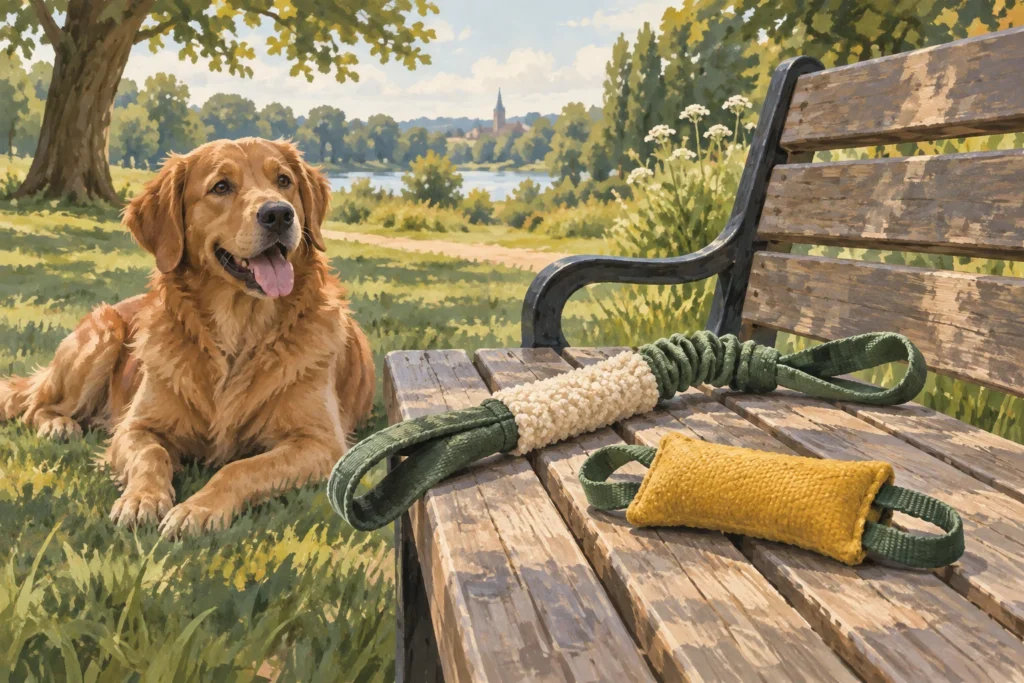
Choose Tug-E-Nuff’s long Faux Fur Bungee Chaser when you want to animate a toy along the ground with more distance between your hand and the bite area. Choose the compact Pocket Fauxtastic when carrying a reward and producing it promptly matters more than reach. The best option follows the game you intend to play and the dog’s ability to play comfortably.
This comparison uses those two named faux-fur designs. It does not cover every pocket tug, squeaker version or natural-fur product in the range, and it does not claim hands-on durability testing.
Table of Contents
The main trade-off is reach versus carrying
| Question | Long Bungee Chaser | Pocket Fauxtastic |
|---|---|---|
| Typical use | Inviting a ground-level chase before a short tug | A compact reward produced during training |
| Space needed | More room to manage the longer handle | Less material to organise in a pocket |
| Handling priority | Keep the line away from legs and obstacles | Keep fingers clear of the intended bite area |
| Buying question | Will the length help the game? | Will the toy fit the carrying routine? |
A long handle can help you move the toy without bending so close to the dog, but it can also trail or tangle in a cramped area. A pocket toy is easy to bring along, yet its shorter reach demands careful presentation. Neither design replaces teaching the dog where to take hold and how to release.
When the Chaser makes sense
This article contains Amazon affiliate links. As an Amazon Associate, we earn from qualifying purchases.
Tug-E-Nuff describes the Faux Fur Bungee Chaser with a long handle and bungee section. Its ground-level movement is the relevant feature for a dog who enjoys following and catching a moving toy. Find Tug-E-Nuff Faux Fur Bungee Chasers on Amazon UK, checking the current dimensions and the exact faux-fur model.
Use a clear, suitable surface and move the bite area away from the dog in a controlled way. Avoid whipping it around the dog’s face, wrapping the handle around limbs or creating repeated tight turns. Do not use the extra reach to encourage high jumps or abrupt airborne catches.
The bungee section changes the feel of the connection, but this article does not claim that it prevents injury or treats joint problems. If the dog has physical restrictions, ask the vet which play movements are appropriate before using a chase game.
When the pocket format is more practical
The Pocket Fauxtastic offers a compact faux-fur tug format for carrying during a walk or training session. Find Tug-E-Nuff Pocket Fauxtastic tugs on Amazon UK, checking that the product is the plain Pocket Fauxtastic rather than a similarly named squeaker or ball version.
Think about where it will live: a coat pocket, training bag or treat-pouch attachment. Keep it separate from food that could make the fabric greasy. Practise taking it out and presenting the bite area without fumbling, while the dog is calm and the environment is easy.
A compact toy can be useful after a successful recall or another trained behaviour, provided the dog enjoys tugging and the location allows safe play. Do not introduce an exciting game in a crowded pavement or beside an unfamiliar dog who may try to join in.
Establish the game before using it as a reward
Offer short, controlled play with the dog’s feet on a suitable surface. Keep movement aligned with the dog rather than lifting or twisting them by the toy. Pause frequently and practise a fair release or exchange. Our tug toy guide covers the broader play format.
RSPCA guidance supports reward-based training. The reward must be something the individual dog wants; a tug will not suit every dog or every moment. If the dog avoids the toy, simplify the presentation or use a different reward rather than shaking it more insistently at them.
Avoid making the game a contest over who can hold on longest. Predictable beginnings and pauses make it easier to use play as part of training and to stop before excitement becomes difficult to manage.
Care and replacement
These are interactive rewards, not items to leave available for unsupervised fabric chewing. Inspect the bite area, stitching, handle and bungee before use. Follow the manufacturer’s washing and drying guidance and remove a toy if material becomes loose or damaged.
A toy that remains interesting because it appears for shared games may earn more use than a pile left on the floor. Store it out of reach after play, especially where another dog might dismantle it.
Choose the Chaser if the longer reach solves a real presentation problem and you have room to use it. Choose the pocket version if your priority is a convenient, promptly delivered reward. Start with the format that fits your ordinary training, then add another only if it serves a different useful purpose.