
Last updated: 9 September 2026
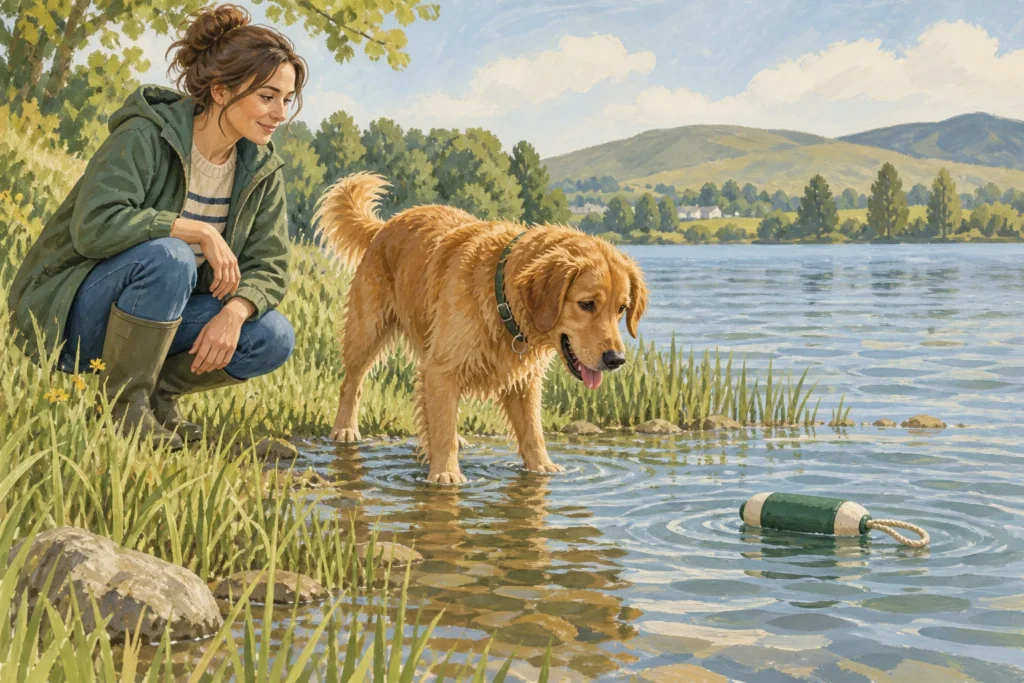
The best floating dog toy is easy for your dog to carry, visible to you and suitable for controlled play in a safe location. A floating label only describes the toy’s behaviour in water; it does not establish that the water is safe or that the dog should swim there. Choose the place and the dog’s activity limits before choosing how far to throw.
Start with shallow, easy access if water play is appropriate for your dog. Some dogs enjoy paddling and retrieving nearby without swimming. There is no need to increase distance simply because the toy is designed to float.
Table of Contents
Compare the useful formats
| Format | Practical appeal | Trade-off |
|---|---|---|
| Floating rubber retriever with rope | Can be picked up or handled using the rope | Rope needs supervision and inspection |
| Soft floating ring | Open shape may be easy to grasp | Size and mouth fit still matter |
| Floating dummy | A dedicated retrieve-training shape | Not necessarily intended for chewing |
| Floating ball | Familiar play format | Must not be small enough to lodge in the mouth or throat |
Check whether the product is intended for retrieval, tugging or chewing. A water toy is not automatically approved for all three. Its colour can help visibility, but glare, waves and vegetation may still make it difficult to track.
KONG Aqua for a rope-and-rubber example
This article contains Amazon affiliate links. As an Amazon Associate, we earn from qualifying purchases.
KONG describes the Aqua as a floating retrieval toy with a foam core and rope. That construction makes it worth comparing if you want a familiar rubber shape intended for water fetch. Find KONG Aqua floating toys on Amazon UK, choosing the correct size and reading the current instructions.
The rope provides a handling point; it should not be looped around the dog or your hand during a throw. Inspect it and the rubber for wear after sessions. This article does not claim a measured throw distance, guaranteed durability or that the toy will remain visible in every water condition.
For an alternative shape, Earth Rated’s Fly toy is described by the manufacturer as a lightweight floating ring made from TPE. Find Earth Rated Fly toys on Amazon UK if a soft ring format suits the dog. Check the exact dimensions and intended use before selecting it; a floating ring is still a play object, not a flotation aid for the animal.
Assess the location without using the toy as a test
Look for safe entry and exit, suitable footing and water conditions that remain within your dog’s ability. Avoid strong currents, steep banks, boating areas and places where a missed retrieve would tempt you or the dog into danger. Follow signs and local restrictions.
Blue Cross warns that blue-green algae can be highly poisonous to dogs. Keep the dog away from water where it is suspected or warnings are posted. If exposure may have occurred, contact a vet immediately rather than waiting to see whether the dog becomes unwell. Do not use a toy to draw the dog into unfamiliar water you have not assessed.
Check water-quality information where available and choose another activity if conditions are uncertain. A favourite toy is replaceable; a difficult retrieval is not a reason to take a risk.
Keep throws close and sessions manageable
Begin with a nearby placement or gentle short throw where the dog can approach comfortably. Give the dog a chance to return and rest between retrieves. Watch the dog, not just the toy, and end while they are still moving comfortably and responding to you.
Do not throw high to encourage jumping from a bank or platform. Avoid repeated long swims and competitive races between dogs. If a dog becomes frantic about the toy, practise calmer land-based play and release skills before adding water.
A properly fitted dog buoyancy aid may be appropriate for some activities, but its handle and flotation do not replace supervision or safe conditions. Seek individual advice if the dog has health or mobility limitations. The enrichment guide offers alternatives when swimming is not suitable.
Clean, dry and inspect after use
Rinse and clean according to the product instructions, then dry it before storage. Check ropes, seams and any openings for grit or damage. If water becomes trapped where it cannot be cleaned or the toy no longer behaves as expected, stop using it and consult the manufacturer.
Buy one suitable toy first and assess how the dog carries and releases it in an easy setting. A modest, well-managed retrieve with a comfortable dog is a better basis for choosing water gear than a promise of extreme distance or indestructibility.