
Last updated: 9 September 2026
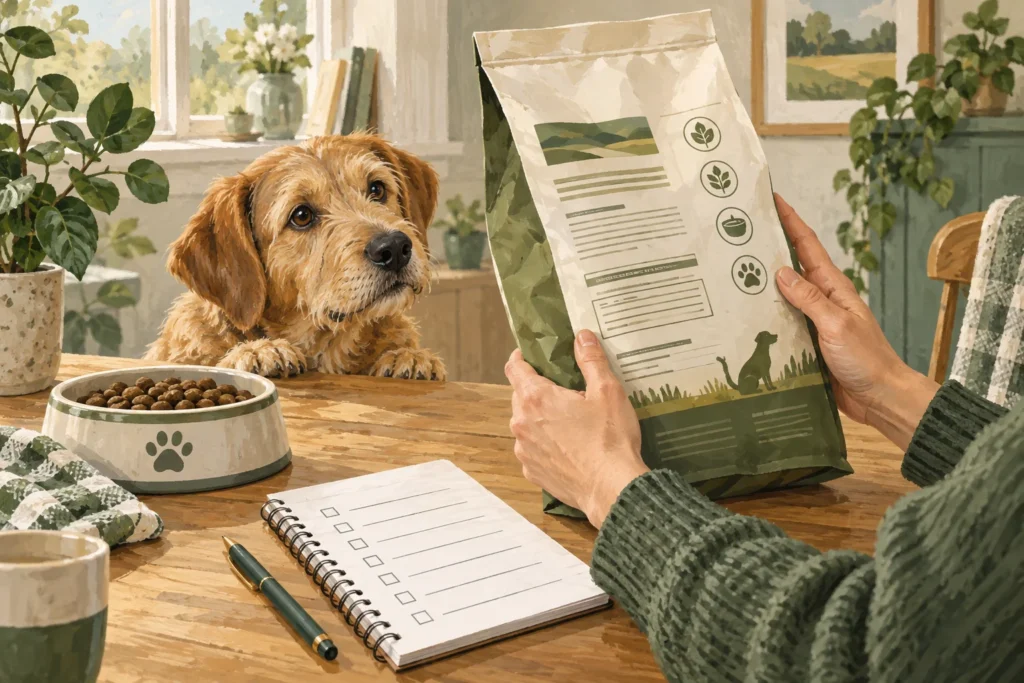
To find chicken-free dog food, read the complete composition rather than relying on the flavour printed on the front. A turkey, lamb or fish recipe can still contain chicken or ingredients described more broadly as poultry. If avoidance is part of a veterinary food trial, ask the vet which exact diet is appropriate before choosing a retail alternative.
There are two different shopping situations here: a personal preference to avoid chicken, and a medically directed need to control dietary exposure. A convenient ingredient shortlist can help with the first; it cannot confirm a diagnosis or establish that a product is suitable for the second.
Table of Contents
Why the named flavour is not enough
Harringtons Rich in Turkey & Vegetable dry food illustrates the issue. Its current manufacturer composition lists freshly prepared chicken and chicken fat alongside turkey and other ingredients. It therefore should not be selected as a chicken-free option simply because turkey leads the name.
This is not a criticism of the recipe. It is a reason to read the back of the bag. A food can accurately describe its named ingredients while also containing other animal sources. The same habit matters when comparing different flavours within one brand.
Check the exact life stage and pack as well. An adult dry recipe, a wet tray and a puppy version with similar branding may have different compositions. Save a photograph of the label you actually buy rather than relying indefinitely on a retailer’s old description.
A practical label-checking sequence
| Step | What to check |
|---|---|
| Confirm the main diet | Complete food for the dog’s appropriate life stage |
| Read composition | Chicken meat, protein, meal, fat, stock or other named chicken ingredients |
| Identify broad terms | Ask about poultry or unspecified animal ingredients where avoidance matters |
| Check the reason for avoidance | Follow veterinary instructions for a diagnostic or therapeutic diet |
| Check all extras | Treats, chews, toppers and other edible rewards |
Do not assume that a broad term proves chicken is present, or that it proves chicken is absent. It tells you the label alone may not answer your question. Ask the manufacturer a precise question about that product, including whether the information applies to the current formulation.
One clearly described recipe to investigate
Burns Original Lamb & Brown Rice currently lists brown rice, dried lamb, oats, lamb fat, peas, seaweed and minerals in its composition. Burns explicitly presents it as an option for dogs needing to avoid chicken. That makes it a useful example for a label-based shortlist, while individual suitability still depends on the dog’s needs.
This article contains Amazon affiliate links. As an Amazon Associate, we earn from qualifying purchases.
Find Burns Original Lamb & Brown Rice dog food on Amazon UK, matching Original Lamb & Brown Rice rather than another Burns recipe. Confirm the current bag and feeding guidance on arrival. This is not a claim that the food treats allergy, or a guarantee concerning cross-contact beyond the information the manufacturer provides.
The recipe contains grains, which is unrelated to whether it includes chicken. Our grain-free food guide covers that separate distinction. Avoiding one ingredient does not automatically require excluding an entire different food group.
Ask useful questions when the label is unclear
Send the manufacturer the exact product name, barcode if available and the ingredient wording that concerns you. Ask which animal species supply a broadly described ingredient and whether the recipe has recently changed. For medically necessary avoidance, pass the response to your vet instead of interpreting processing details yourself.
A statement such as hypoallergenic is not a guarantee that no dog can react to the food. PDSA explains that suspected food allergy needs veterinary investigation, often involving a controlled diet trial. Repeatedly switching between ordinary foods can make the picture less clear.
Do not exclude necessary foods based on an online symptom checklist. Itchy skin and digestive problems can have other causes, and a vet can help investigate them appropriately.
Keep the whole feeding routine consistent
Write down what the dog actually eats across the week. Include training rewards from other household members, chews left by a sitter and food hidden in toys. If a veterinary plan requires strict control, those extras need to fit it too.
For an ordinary change of complete food, follow suitable transition advice and monitor how the dog gets on. Do not buy a very large sack before knowing the recipe is practical for your household. Compare daily feeding cost and storage as well as the ingredient list; the main dog food guide provides broader buying criteria.
The most reliable chicken-free choice is an exact recipe with a clear current composition, chosen for a clear reason. Keep the bag information and revisit it when packaging or recipes change.