
Last updated: 9 September 2026
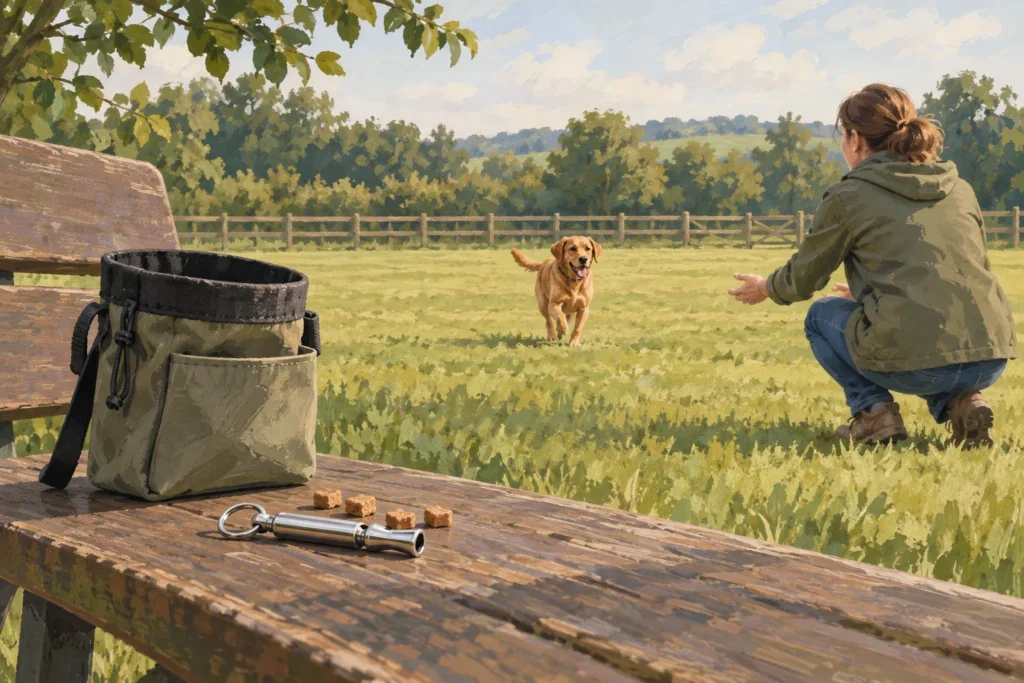
The best dog whistle for recall is one you can sound consistently, carry reliably and pair with a well-practised reward. A fixed-tone whistle is a straightforward choice for most households. An adjustable model offers more control over pitch, but it also introduces a setting you must keep consistent. Neither works as an automatic return button.
Choose the sound and handling before worrying about specialist claims. If two people walk the same dog, agreeing on one signal pattern and using matching equipment may matter more than buying an elaborate whistle with several functions.
Table of Contents
Fixed or adjustable pitch?
| Type | Useful for | Trade-off |
|---|---|---|
| Fixed single tone | A simple shared recall signal | Less choice if the pitch does not suit your routine |
| Adjustable pitch | Owners who want to select and retain a particular setting | The setting needs securing and checking |
| Two-tone whistle | Distinct established signals for different trained tasks | More opportunities for accidental inconsistency |
| Combined clicker and whistle | Carrying two training tools together | The two sounds still need different meanings |
A click normally marks a behaviour you are rewarding; a recall whistle asks the dog to return. A combined tool does not make those functions interchangeable. Keep the signals clear, particularly when several family members are learning together.
Two Coachi options worth comparing
This article contains Amazon affiliate links. As an Amazon Associate, we earn from qualifying purchases.
The Coachi Dog Whistle produces a single tone and has an adjustable reflective lanyard, according to the manufacturer. It is a practical model to investigate if you want a compact, uncomplicated signal. Find Coachi single-tone dog whistles on Amazon UK, checking the exact product name rather than buying an unrelated high-frequency version by mistake.
The Coachi Professional Whistle allows pitch adjustment. Company of Animals describes adjusting the internal setting and tightening it to retain the chosen pitch. Find Coachi Professional adjustable whistles on Amazon UK if that flexibility is useful, and read the current adjustment instructions before use.
These examples are selected for their different controls, not ranked by an unperformed distance or sound test. No whistle can guarantee that a distracted dog will respond. If a dog has suspected hearing changes, discuss them with your vet rather than simply buying a higher-pitched model.
Check the handling in ordinary walking conditions
Can you find the mouthpiece without looking and use it with gloves on? Does it sit comfortably in a pocket without filling with grit? Can you clean it according to the instructions? Those details influence whether you will have the whistle available when needed.
A lanyard can prevent loss, but it should not create an entanglement risk. Keep it away from children and from the dog’s mouth during play. If you dislike wearing one, choose a secure pocket or attachment that lets you access the whistle without dropping the lead.
Buy a spare of the same model once you know it suits you. Check that the sound and any adjustable setting match before relying on it. A replacement described only as a dog whistle may sound quite different from the familiar cue.
Give the signal meaning before adding distance
Begin recall work somewhere quiet and safely enclosed, with rewards ready. Establish that coming to you leads to something worthwhile. Add the whistle within a reward-based training plan rather than repeatedly sounding it at a dog who has not learned what it predicts.
Our recall training guide covers developing the behaviour. RSPCA guidance supports gradual practice and safe management while recall is being learned. Build distractions and distance separately; a successful response in the kitchen does not establish readiness beside wildlife or a busy road.
Agree a short signal pattern across the household. Write it down if necessary. Repeated blasts in moments of frustration can make the cue inconsistent and difficult to interpret. Reward returns generously and avoid making every recall the immediate end of all enjoyable activity.
Know what a whistle cannot change
Wind, surroundings, distance and the dog’s attention all affect a real walk. Do not use an advertised range as permission to let the dog travel beyond a manageable distance. Maintain appropriate lead or long-line control where recall is not reliable, following safe handling and local rules.
A whistle also cannot make livestock, traffic or a frightened dog’s escape risk unimportant. Choose the environment to match the current training, not the confidence inspired by a new purchase.
For most owners, the buying decision is modest: one clear, repeatable sound, convenient carrying and a matching spare. The substantial work is building the dog’s understanding and keeping the cue valuable over many ordinary, successful repetitions.