
Last updated: 9 September 2026
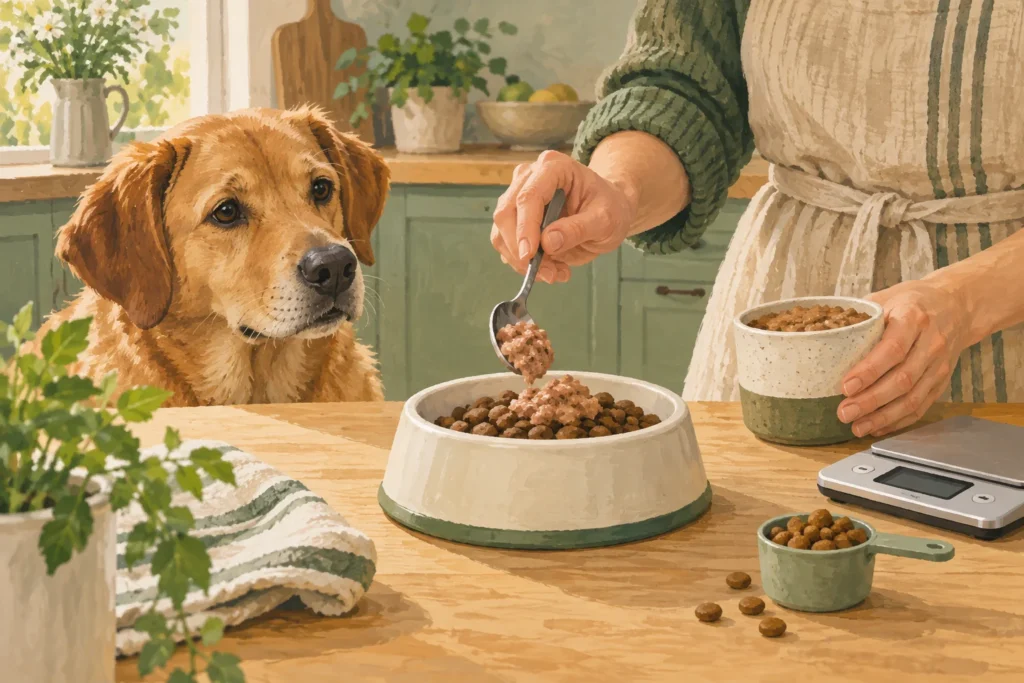
Dog food toppers are optional additions to a meal. They may change its texture or help you use a small amount of another suitable food, but they are not automatically needed to improve a complete diet. Before buying, decide what the topper is for and how much of the daily food allowance it will replace.
If a dog has newly lost interest in food, do not keep escalating toppings instead of discussing the appetite change with your vet. A topper also needs approval when the dog follows a prescribed diet or an allergy investigation; a small extra can still contain an ingredient the feeding plan excludes.
Table of Contents
Understand the label before the front-of-pack promise
The key distinction is complete versus complementary. A complete food is intended to supply a balanced diet when fed appropriately. A complementary product needs other food alongside it. A high meat percentage alone does not establish that a tray can replace the main meal.
Forthglade provides a clear example: its FAQ distinguishes the complementary Just 90% range from its complete meals. Similar-looking trays can therefore have different feeding roles. Check the precise recipe and declaration, rather than buying by brand name or assuming every product in the same multipack category serves the same purpose.
Compare the useful types
| Type | Possible use | Check carefully |
|---|---|---|
| A measured portion of complete wet food | Changing the texture of part of a meal | The combined wet-and-dry allowance |
| Complementary meat-based tray | A small addition within an appropriate feeding plan | Calories, ingredients and the amount recommended alongside other food |
| Powder or crumb topper | Adding a small measured sprinkle | Serving weight and whether nutritional claims are supported |
| Oil or functional supplement | A specific purpose discussed with the veterinary team | Individual suitability, dosing instructions and other dietary sources |
Do not assume the last two categories are harmless because the serving looks small. A concentrated product may add significant calories or duplicate ingredients already supplied elsewhere. Avoid building a stack of extras around several overlapping health claims.
Make the portion visible
Measure what you add rather than judging a spoonful by eye. Ask the manufacturer for calorie information if it is not available on the label, and ask your vet or vet nurse how it fits your dog’s daily allowance. Replacing food gram for gram can be misleading because different products have different energy densities.
As an illustrative calculation, suppose a topper supplies 120 kcal per 100g. A 20g serving would supply 24 kcal. That calculation does not tell you whether 20g is appropriate for your dog; it simply makes the extra energy visible so it can be accounted for. Use the actual label values, not these example figures.
Buy a pack that suits a small daily addition
Large packs may look economical but become wasteful if the opened food cannot be used within its stated storage period. Check refrigeration, freezing and thawing directions for the particular product. Do not assume every wet topper can be frozen or kept open for the same number of days.
This article contains Amazon affiliate links. As an Amazon Associate, we earn from qualifying purchases.
If comparing Forthglade’s complementary range, Find Forthglade Just 90% complementary food on Amazon UK. Read the selected pack’s label and keep its role separate from a complete meal. Search results may show both complete and complementary products.
Compare cost per serving, including waste
Divide the pack price by the number of servings you can actually use. For example, an illustrative £3 pack used for ten suitable portions costs 30p per portion. If storage limits mean half is discarded, its practical cost doubles. A smaller pack at a higher price per kilogram may work out better for a dog needing only a small amount.
Record how the topper changes the overall food bill, not just the price of the additional packet. If it replaces a measured part of a complete wet meal, the calculation differs from adding it on top of every existing portion. Our dog-food guide can help you assess the main diet first.
Keep the decision proportionate
Choose one suitable addition, use a consistent measured amount and observe whether it serves the intended purpose. A topper does not need to make every meal more elaborate. If your dog already enjoys an appropriate complete food and maintains a suitable body condition, there may be nothing to buy.
Keep the recipe name and feeding directions with the food, especially when several people feed the dog. An optional extra works best when everybody understands its portion and purpose, rather than independently adding a little more because the dog looks interested.