
Last updated: 9 September 2026
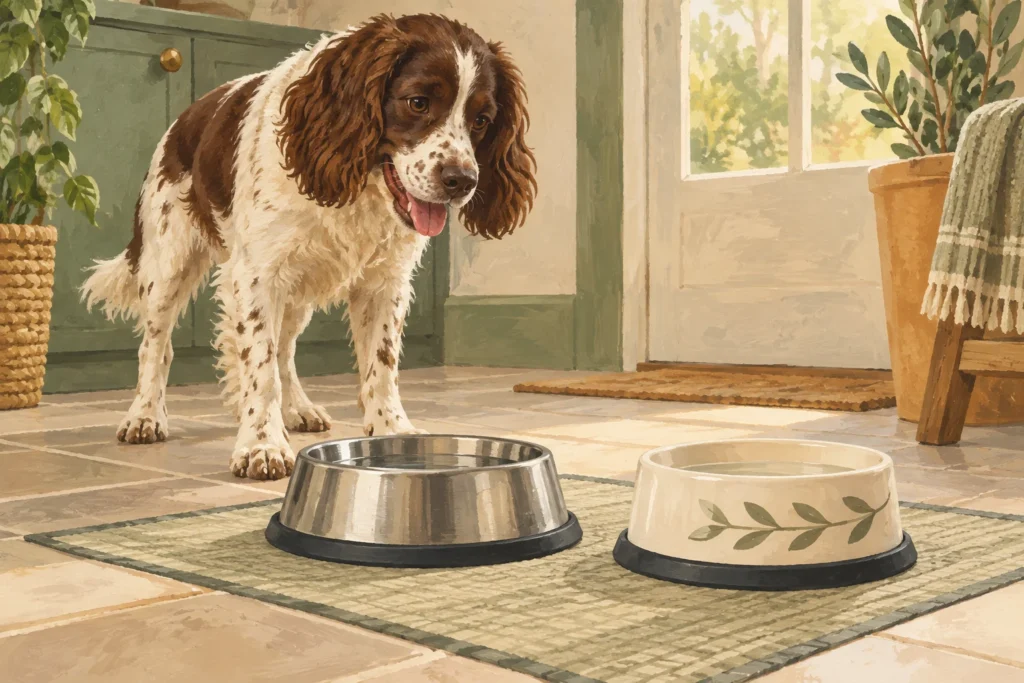
A good non-slip dog bowl stays reasonably stable on your actual floor while letting your dog reach the food comfortably. The base matters as much as the bowl material: a heavy bowl can still slide on smooth tiles, while a light bowl with an effective rubber ring may remain steadier. Choose the design for the problem you see rather than buying the largest or heaviest option available.
This is a comparison of useful bowl designs and buying criteria. We have not measured sliding resistance in a laboratory, and no bowl here comes with a promise that an enthusiastic dog cannot move it.
Table of Contents
Is the bowl sliding, tipping or being carried?
Watch an ordinary meal. A bowl travelling steadily across the floor needs more grip. One that overturns as the dog reaches the last few pieces may need a broader base or a different depth. A dog picking up the bowl creates a different problem again: adding weight is not necessarily the right response, particularly if it makes a dropped bowl hazardous.
Check the surface underneath before replacing anything. Water, food residue and a loose mat can undermine an otherwise sensible base. Clean and dry the floor and the bowl’s underside, then assess the setup again. A feeding mat helps only when the bowl and mat both remain stable.
Three designs worth comparing
| Design | Where it may suit | Main buying check |
|---|---|---|
| Stainless-steel bowl with a grip ring | A lightweight daily bowl that is easy to lift and wash | Whether the ring is secure, removable for cleaning and replaceable |
| Wide moulded bowl with rubber feet | A dog nudging or tipping a narrow bowl | The food-contact material, usable opening and care instructions |
| Plain bowl on a fitted silicone mat | Keeping a familiar bowl while improving the surrounding setup | Mat dimensions, floor grip and accessible edges a dog might chew |
Do not assume that a bowl stand solves every movement problem. The dog still needs comfortable access, and the whole stand can shift if its feet slide. If a vet has advised a particular feeding position, follow that individual guidance rather than buying a raised bowl because it is marketed as healthier.
A documented example: the Omlet bowl
Omlet describes its small bowl as melamine with a rubber foot, a 17cm diameter, 5cm height and 0.5-litre capacity. It lists dishwasher cleaning for the bowl. These details make it a useful example of a broad, purpose-shaped bowl rather than a thin steel dish. They do not tell us how much your dog’s muzzle fits inside the usable opening or prove that it will remain stationary on your floor.
Check the current size chart before comparing the small, medium and large versions. External diameter, internal eating space and capacity answer different questions. A bowl advertised as holding half a litre is not a recommendation to serve half a litre of food.
This article contains Amazon affiliate links. As an Amazon Associate, we earn from qualifying purchases.
For marketplace alternatives with clear material and base descriptions, Find non-slip stainless-steel dog bowls on Amazon UK. Compare the seller’s measurements and photographs with your existing bowl; search results may include different sizes and designs.
Measure the meal and the muzzle
Start with the normal measured food portion. It should fit without creating a heap that spills over the edge, while leaving enough room for the dog to eat without awkwardly reaching into a narrow well. Flat-faced dogs may need a more open profile. Dogs with long ears may benefit from a shape that keeps the ears out of the meal, but a narrow opening must still allow comfortable access.
For example, if your current bowl is stable but your dog pushes food into the corners, changing the internal shape may matter more than buying stronger feet. If the bowl works until it is almost empty, compare a wider base and shallower sides. Photograph the current problem so you can assess replacements against a real need.
Cleaning can change the buying decision
A grip ring creates another surface to inspect. Look beneath removable parts for trapped moisture and food residue, and follow the maker’s cleaning directions for both the bowl and its base. Dishwasher-safe claims should identify the exact component; they do not automatically cover an attached mat or stand.
Discard damaged food-contact surfaces and replace deteriorating rubber parts. If the manufacturer does not sell a replacement foot, include that in the lifetime-cost comparison. Buying two straightforward bowls can also make it easier to provide a clean one while the other is being washed and dried.
Choose stability without changing the feeding job
A non-slip bowl and a slow feeder solve different problems. If you want obstacles that change how food is accessed, read our slow-feeder guide and assess its base separately. Do not assume a grippy bowl controls eating speed or prevents disease.
For a first purchase, prioritise a comfortable opening, a secure washable grip system and a clear return policy. Try it during a supervised normal meal, check whether the original problem improved and keep the packaging until you know it fits your routine.