
Last updated: 9 September 2026
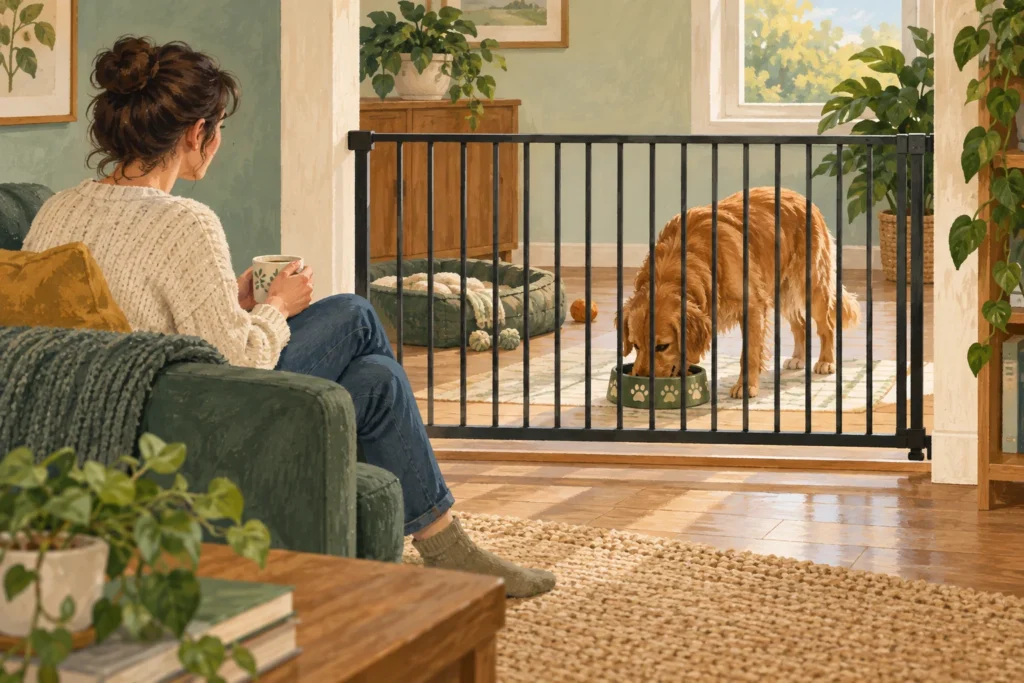
Resource guarding in dogs needs a safety-first response: stop competing over the item, create space and arrange appropriate professional help. Food, toys, stolen objects and resting places can all be involved. Do not test how close you can get or repeatedly take things away to prove that you are in charge.
This article contains Amazon affiliate links. As an Amazon Associate, we earn from qualifying purchases.
Table of Contents
Recognise the situation without provoking it
A dog may become still, move away with an item, eat faster, growl or snap when someone approaches. These behaviours need context; an internet description cannot assess the whole case. If there has been a bite or you cannot manage access safely, seek individual advice promptly.
Keep children away from the dog when resources are present and prevent them approaching a resting area. Adults remain responsible for the arrangement. A child should never be asked to demonstrate taking a toy or feeding from their hand to solve guarding.
Make meals and valued items predictable
Feed in a quiet protected space where people and pets do not need to pass closely. Allow the dog to finish undisturbed. Collect bowls only when the dog has moved away and the area can be managed safely.
Separate pets for meals and high-value items where needed. Giving two dogs identical chews beside each other does not remove competition. Each needs enough space and a management arrangement suited to the household.
| Situation | Safer management aim |
|---|---|
| Food bowl | No reaching into the bowl or crowding the dog while eating. |
| Chew or toy | Use in a protected area and avoid repeated taking. |
| Stolen household object | Prevent access to similar objects and avoid chasing or cornering. |
| Bed or resting place | Keep an undisturbed retreat and seek help with necessary movement. |
| Several pets | Control access to resources and prevent forced sharing. |
Use barriers as an arrangement, not a punishment
A gate or separate room can help keep people from accidentally entering the dog’s space, provided the dog is comfortable with the setup. Find a suitable dog safety gate on Amazon UK. Choose and fit a barrier that the dog cannot readily cross or dislodge.
Put management in place before offering a valued item. Trying to manoeuvre a gate around a dog already guarding something can increase pressure. Make sure everyone knows how the space is being used, including visitors and occasional carers.
Avoid confrontational experiments
Do not remove the bowl repeatedly, put your hands into food, chase the dog or physically force their mouth open as a training exercise. Punishing a growl can remove an observable warning without resolving the concern behind it.
Trading can be part of a professionally planned approach, but a generic instruction to offer a treat is not sufficient for every guarding case. If the dog is tense or there is a bite risk, do not practise exchanges around a valued object without guidance.
If the object could be dangerous
Keep people at a safe distance and contact your vet promptly if ingestion or injury is possible. Explain what the object is and what the dog may have swallowed. Do not create an additional bite risk by attempting an unsafe retrieval.
A professional can help plan prevention and emergency handling for the future. Secure bins, laundry, food and other repeatedly stolen items so the same situation is less likely to arise while you are getting support.
Gather useful information for the professional
Write down the resource involved, who was nearby, the distance at which the dog reacted and what happened immediately before and after. Include health changes and any history of incidents. Use existing safe observations; do not recreate the event for filming.
Start with your vet, particularly for new behaviour or possible pain. Ask about referral to an appropriately qualified clinical behaviour practitioner. ABTC’s role information explains how clinical behaviour support differs from an ordinary skills class.
Keep the plan manageable for the whole home
Agree a few clear routines that everyone can follow: where meals happen, which items are put away and when the dog needs protected space. If the arrangement is not workable, tell the professional. Successful support has to fit real doors, people and daily routines, with safety maintained while learning develops.