
Last updated: 9 September 2026
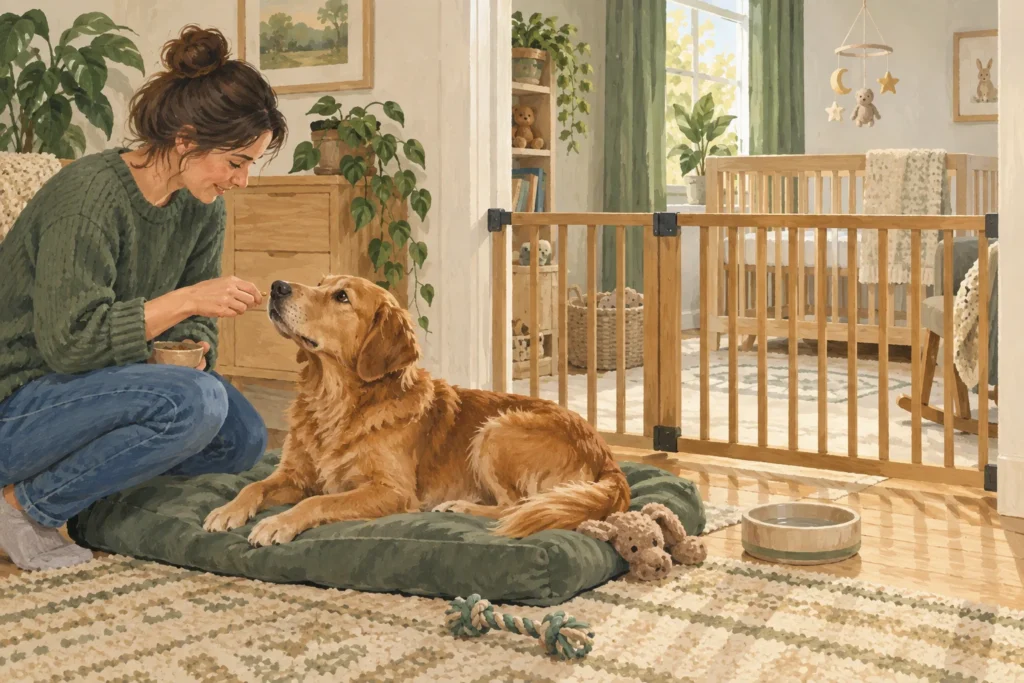
Preparing your dog for a new baby works best when the household changes begin gradually, before the baby comes home. Plan who will meet the dog’s daily needs, introduce new equipment at a comfortable pace and establish safe separate spaces. The first introduction is only one part of a much longer adjustment.
This article contains Amazon affiliate links. As an Amazon Associate, we earn from qualifying purchases.
Table of Contents
Map the routine that will actually change
Think about walks, meals, resting places and access to rooms. If the dog will no longer sleep in a particular area or needs to be comfortable behind a gate, begin teaching that arrangement ahead of time. Making every restriction on the day the baby arrives is a difficult transition.
Identify backup help for hospital visits, recovery and disrupted nights. Give that person written feeding, walking and veterinary details. It is easier to ask for a specific task than to discover at short notice that nobody can cover the dog’s usual outing.
Create comfortable separation before you need it
Set up a resting area where the dog can be near family life without accessing the baby. Introduce it with familiar bedding and quiet, positive experiences. Do not use the space only when something exciting is happening elsewhere.
A portable mat can also provide a familiar location while an adult sits nearby; Find a washable dog settling mat on Amazon UK. Practise settling independently of baby-related activity, with short sessions the dog can comfortably manage. A mat cue is helpful but does not serve as a physical safety barrier.
Introduce equipment in small pieces
Let the dog notice the pram, cot or other new objects without being cornered by them. Begin with equipment still, then add modest movement where appropriate. Reward comfortable responses and provide room to move away.
A pram moving beside a person can be a different experience from one parked in the hall. Practise handling it without the baby in an easy setting, with appropriate lead control and enough space. Do not attach the dog’s lead to the pram.
| New feature | Gentle preparation |
|---|---|
| Changed room access | Teach a pleasant alternative resting place before closing access routinely. |
| Pram movement | Practise gradually without the baby, away from busy routes. |
| Baby sounds | Use carefully controlled low-level exposure only while the dog remains comfortable. |
| Adults sitting with occupied hands | Reward an established calm alternative nearby. |
Do not use sound recordings to overwhelm
If you use recordings, start quietly enough that your dog is comfortable. Increase only when the current level is easy, and stop if they show concern. Loud crying played repeatedly is not a way to make a dog get used to it faster.
Recordings cannot recreate every feature of a baby. Their value is limited preparation, not a guarantee of how the dog will respond after birth. Existing sensitivity to noise or changes in the home is a reason to get qualified advice earlier.
Make the homecoming calm
Arrange enough adult help to manage the dog and baby separately. Let the dog greet a returning familiar person without needing immediate access to the baby. Follow current professional guidance for the introduction and keep contact controlled, brief and optional.
Never leave the dog and baby alone together. Do not place the baby on the floor beside the dog for a photograph or encourage face-to-face investigation. The dog should have an escape from interaction, while an adult remains responsible for preventing unsafe access.
Protect the dog’s needs after the first week
Keep opportunities for rest, appropriate activity and familiar positive interaction in the new routine. Small predictable periods can be valuable when long sessions are impractical. Watch for changes in appetite, resting or behaviour and seek veterinary advice where needed.
Visitors can add another layer of excitement. Plan their arrival so they do not crowd the dog while everyone focuses on the baby. A household that is manageable on a quiet afternoon may need a different setup when several relatives visit.
Get help before a difficulty becomes urgent
Discuss fear, guarding, previous bites or difficulty with separation with your vet and an appropriately qualified behaviour professional before the birth where possible. Do not rely on breed stereotypes or previous affection towards adults to predict safety with a baby. Individual preparation and continuing supervision remain essential.