
Last updated: 9 September 2026
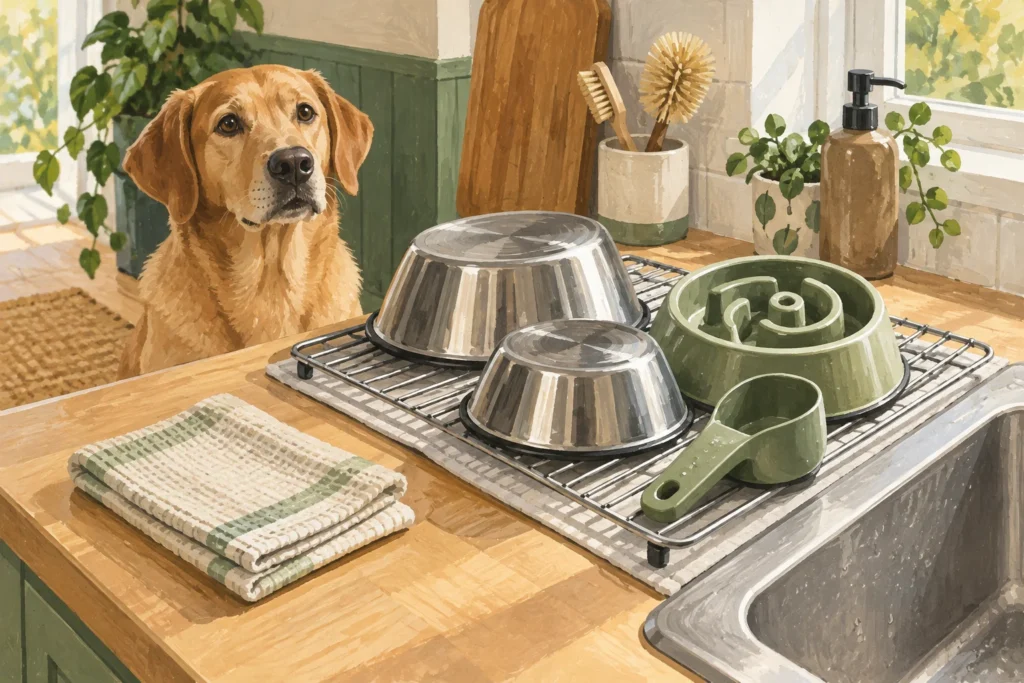
Clean dog food bowls and feeding toys after use, remove food from grooves and seams, and let washed equipment dry before putting it away. A bowl licked clean still needs washing. Water bowls also need regular washing and fresh water, rather than endless topping up.
The easiest routine starts with equipment you can actually reach inside. A clever slow-feeder pattern loses its appeal if dinner stays trapped in a corner you cannot scrub or inspect.
Table of Contents
A practical washing sequence
- Remove leftovers. Dispose of uneaten food according to the food’s storage and serving guidance.
- Take apart removable components. Lift out seals, inserts or rubber bases only where the maker permits it.
- Wash all food-contact surfaces. Use appropriate washing-up detergent and water, or the specified dishwasher method.
- Inspect the awkward areas. Look beneath rims and between slow-feeder ridges.
- Rinse and dry. Follow product directions and keep clean equipment away from dirty brushes and surfaces.
If additional disinfection is needed, first remove visible dirt, then use a product suitable for the surface and intended food-contact use. Follow its dilution, contact-time and rinsing instructions. Do not mix cleaning chemicals or improvise a strong solution on the assumption that stronger must be safer.
Different designs need different attention
| Item | Commonly missed area | Useful check |
|---|---|---|
| Ordinary bowl | Underside of rim and removable base | No greasy film or trapped debris |
| Slow feeder | Sharp corners and narrow channels | A brush can reach the complete pattern |
| Hollow rubber toy | Inner cavity and smaller opening | Look through and check for stuck filling |
| Food scoop | Handle joint and inside corners | Clean and fully dry before returning to food |
| Feeding mat | Edges and floor beneath | No food left under the bowl station |
This article contains Amazon affiliate links. As an Amazon Associate, we earn from qualifying purchases.
A dedicated brush can make narrow channels easier to clean. Find small bottle brush for cleaning dog food toys and bowls on Amazon UK. Choose bristles that reach the spaces without damaging the surface, and clean and dry the brush itself. A worn dirty brush should not become a permanent part of the routine.
Check what “dishwasher safe” applies to
A product may have one dishwasher-safe component and another that must be hand washed. An automatic feeder’s bowl, for example, can have different instructions from its motorised base. Keep electrical parts away from immersion unless the manual explicitly permits it.
KONG’s cleaning advice provides a good example of product-specific care: its classic rubber food toys can use the top rack, with the heated drying cycle avoided. That does not establish the same rule for every toy with the KONG name, or for another brand’s rubber and fabric products.
Load equipment so water can reach the dirty surfaces rather than stacking bowls tightly together. Afterwards, inspect recesses rather than assuming the end of the cycle proves all stuck food has gone. If a slow feeder is too awkward for your usual washing arrangement, a simpler pattern may be the better purchase.
Raw food needs particular separation
UKHSA and APHA advise washing hands after handling raw pet food and cleaning and disinfecting the surfaces and utensils it touches. They also advise storing and defrosting it away from human food. Plan the process before opening the packet so contaminated packaging, bowls and utensils do not travel across the kitchen.
Use dedicated equipment for raw-food preparation, keep it away from children’s items and clean the feeding area after the meal. Follow current official guidance and the product’s label. Freezing, a “natural” description or a dog looking healthy does not remove the need for hygiene.
For a household with someone at increased infection risk, discuss the feeding and cleaning arrangement with the relevant healthcare and veterinary professionals. Do not assume an ordinary quick rinse makes every food-handling situation equivalent.
Make the routine easy to maintain
Two suitable bowls can be more useful than one complicated premium feeder: one can be clean and ready while the other is being washed. Keep a small drying area separate from dirty equipment and do not put a wet scoop straight into a bag of dry food.
Replace damaged items when cracks, rough edges or deep wear make effective cleaning difficult. Check that a removable insert has not started to split and that no small piece can come loose. A bowl that still holds food is not necessarily in good condition.
Our slow feeder buying guide helps compare patterns and materials. Before choosing one, picture the washing-up after a sticky meal. If you can reach every surface and repeat the process easily, you are much more likely to keep the feeder useful.