
Last updated: 9 September 2026
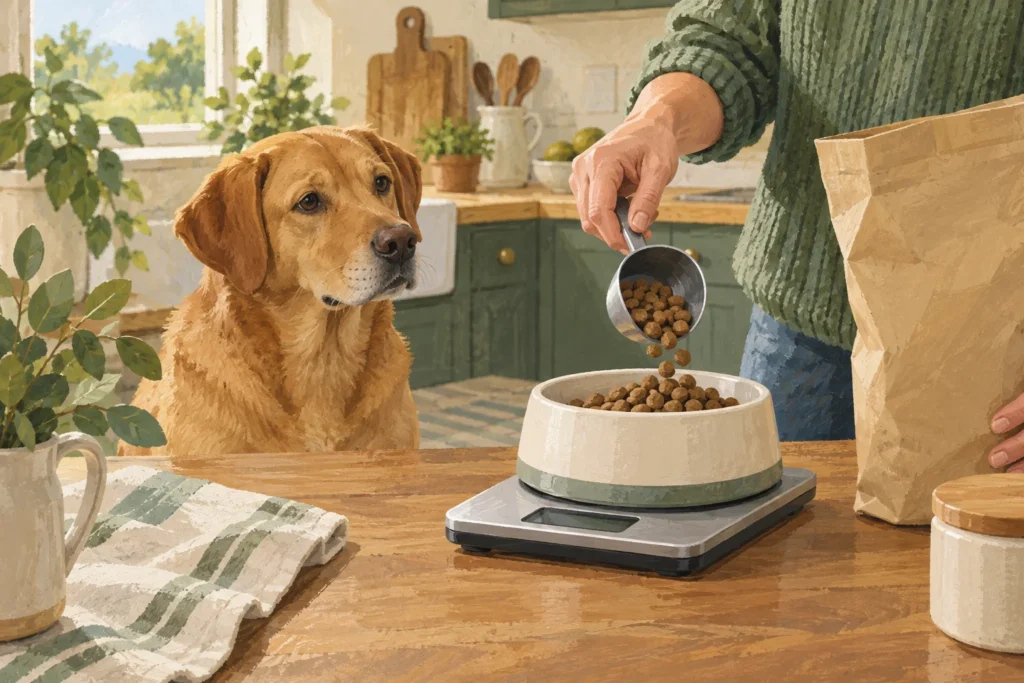
To work out how much to feed your dog, start with the feeding guide on the exact food you use, weigh the daily amount and account for every extra. Then review your dog’s weight and body condition. A packet guide is a starting point; it cannot know your dog’s activity, health or individual energy needs.
There is no useful single answer in grams for “a medium dog”. Two foods can contain very different calories per gram, while two dogs of the same size may need different amounts. The practical aim is a repeatable feeding routine that you can adjust with your vet when necessary.
Table of Contents
Read the correct line on the packet
Check that the food is complete and appropriate for your dog’s life stage. Find out whether the table uses current weight, expected adult weight or another basis: puppy and adult guides can work differently. Also check whether the listed amount is per day or per meal. Misreading that heading can double the ration immediately.
If your dog is underweight, overweight, pregnant, nursing or has a medical condition, ask your veterinary team which weight and feeding target to use. Simply choosing a smaller number from the table is not a tailored weight-loss plan. For an otherwise healthy adult, write down the label’s starting allowance alongside the food name and recipe.
Make one daily allowance, then divide it
As an arithmetic example, suppose an appropriate starting allowance is 240g of a particular dry food each day. If you reserve 30g for training, 210g remains for meals. Split across two meals, that is 105g in each bowl plus the reserved training food. This illustrates bookkeeping, not the correct ration for your dog.
Use the tare function to zero the bowl before weighing. A marked scoop is convenient for serving, but weighing is more repeatable when kibble size or the fullness of the scoop changes. UK Pet Food specifically recommends accurate kitchen scales rather than estimating by volume.
This article contains Amazon affiliate links. As an Amazon Associate, we earn from qualifying purchases.
Find digital kitchen scales with gram measurements and tare on Amazon UK. A stable scale with a clear display, gram measurements and a tare button is enough; an expensive pet-branded device is unnecessary. Check that it reads small portions reliably and that the bowl does not hide the display.
Count food that never reaches the bowl
| Extra | How to record it |
|---|---|
| Training kibble | Take it from the weighed daily ration |
| Commercial treats | Record calories per piece or weigh the amount used |
| Dental chew | Include its energy in the day’s food calculation |
| Food in a puzzle or licking toy | Count the filling, including any topping |
| Another family member’s rewards | Use a shared pot or written allowance |
UK Pet Food advises keeping treats to no more than 10% of daily calories. That is an upper limit, not a target, and individual diet plans may require stricter rules. Ten per cent by weight is not the same thing. A small fatty treat can contribute more energy than a much heavier portion of wet food.
Mix wet and dry food without doubling dinner
Do not serve the full daily wet allowance alongside the full daily dry allowance. Use the manufacturer’s mixed-feeding instructions or ask for help converting the intended proportions. If you want half the energy from each complete food, that does not generally mean equal weights of each food.
For an illustrative calculation, if a full-day dry ration were 200g and a full-day wet ration were 800g, half of each allowance would be 100g dry plus 400g wet. This only works when both full-day figures represent the same appropriate energy target. It is not a prescription or a shortcut around an unclear label.
Review the dog as well as the numbers
Keep a simple record of food, extras and weight, using a consistent weighing method. Ask your vet or nurse to demonstrate body-condition assessment on your dog; coat thickness and breed shape can make a visual guess misleading. Changes in exercise, neutering, age and health can alter what works.
Unexpected weight change, persistent hunger with weight loss, vomiting, diarrhoea or reduced appetite deserves veterinary advice. Avoid repeatedly switching foods or making large cuts without understanding the problem. A useful review ends with a clear next amount and a date to reassess it.
Our dog food buying guide can help compare suitable complete foods. Whatever the brand, keeping a measured daily allowance is what makes the feeding guide useful in your kitchen.