
Last updated: 9 September 2026
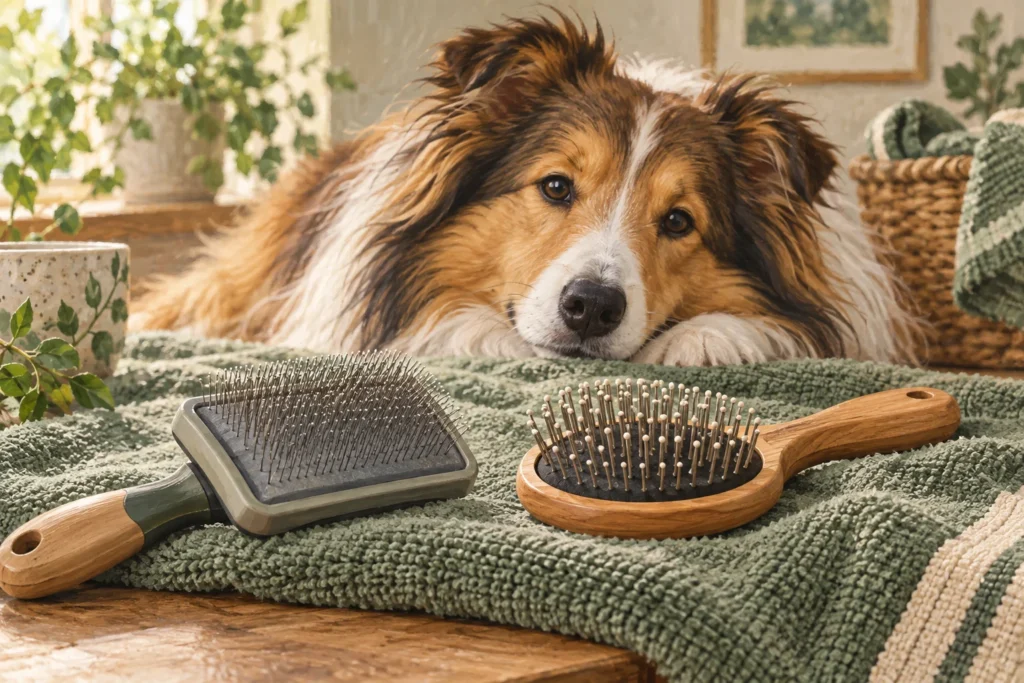
The slicker brush vs pin brush choice depends on coat type and what you need the brush to do. A slicker has closely spaced fine wires; a pin brush has more widely spaced pins. Both need a gentle technique and suitable pin length. Neither is a reason to pull through a painful mat.
If the coat is tightly matted, especially close to the skin, ask a qualified groomer for help. Redness, sores or apparent pain need veterinary advice. Buying a stronger brush can make an uncomfortable problem worse.
Table of Contents
Start by identifying the grooming task
| Task | Tool to discuss with your groomer | Important limit |
|---|---|---|
| Working through a suitable long or textured coat | Pin brush or appropriate slicker | Pin length and technique must suit the coat |
| Removing loose hair from a suitable coat | Coat-specific slicker or other recommended tool | More pressure does not improve the result |
| Checking for remaining small tangles | Suitable comb after brushing | Do not drag a comb through resistance |
| Dense mats close to skin | Professional assessment | A home brush comparison does not solve safe mat removal |
What a slicker offers
Fine, closely spaced wires can work through suitable coats and collect loose hair. The head may be flat, curved or flexible, and the wires can vary in length and stiffness. Those differences matter more than choosing by the word “slicker” alone.
Mikki’s Classic Pro Slicker is an example with different pin characteristics on its two sides and a flexible head. That gives owners a specific design to discuss with a groomer, rather than assuming every slicker is equally suitable for a delicate or dense coat.
This article contains Amazon affiliate links. As an Amazon Associate, we earn from qualifying purchases.
Find Mikki Classic Pro Slicker on Amazon UK. Check the exact product and size. A self-cleaning button or flexible head can make the tool more convenient, but it does not control the pressure your hand applies.
What a pin brush offers
A pin brush’s wider spacing can make it useful for working through sections of suitable longer coats. Look at the finish of the pins, the cushion and whether the pins reach the area you intend to brush without scraping skin.
Wahl’s grooming range includes pin-style and other brush designs. Find Wahl dog pin brush on Amazon UK if that is the type your groomer recommends. A combined pin-and-bristle brush may save storage space, but the two sides still have different jobs.
Do not assume a pin brush has removed every tangle because the outer coat looks smooth. The important question is whether the relevant coat layers are being maintained comfortably, not whether the top looks glossy for a photograph.
Ask for a demonstration on your dog
The most valuable part of a grooming appointment can be a few minutes showing how to hold a section of coat and where to begin. Ask which areas need special attention, how to recognise a small manageable tangle and when to stop.
Take your own brush along if you already have one. A groomer may be able to show that it is suitable with a different technique, saving an unnecessary purchase. Alternatively, they may identify that the pins are too short, bent or poorly suited to the coat.
Make brushing comfortable and repeatable
- Use a stable surface and a position the dog can maintain comfortably.
- Start with a small easy area and gentle strokes in the appropriate direction.
- Check the skin and the dog’s response rather than watching only the brush fill with hair.
- Pause at resistance; do not repeatedly rake the same sore spot.
- Reward comfortable participation and keep early sessions manageable.
- Clean the tool and inspect its pins after use.
A damaged pin or trapped debris can make a familiar brush unpleasant. Replace a tool whose surface is no longer safe to use rather than keeping it because the handle remains intact.
Do you need both?
Some coats benefit from a small set of tools with distinct purposes. Others need a simpler routine. Our shedding brush guide covers another common task, and the grooming kit guide helps assess a complete kit.
Buy the tools you can explain: this brush for this coat task, this comb for checking, and professional help for work beyond that routine. A drawer full of brushes is less useful than one appropriate tool and a technique your dog finds comfortable.