
Last updated: 9 September 2026
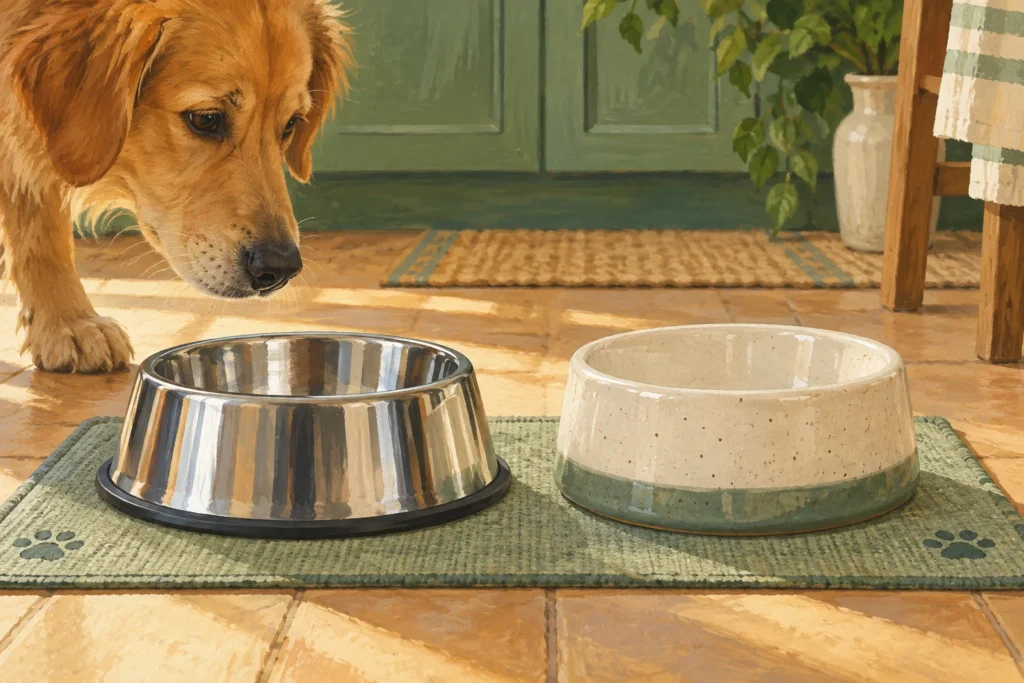
Stainless steel vs ceramic dog bowls is mainly a decision about handling, stability and damage. Steel is often easier to carry and less vulnerable to breaking when dropped. Ceramic can provide a heavier base and a finish you prefer in a permanent feeding area. Choose a suitable shape and a bowl you will clean reliably before deciding by appearance.
Neither material stays hygienic simply because of its name. Food residue, water deposits, damage and the care routine still matter. A good steel bowl left dirty is not a better feeding arrangement than an intact ceramic bowl washed properly.
Table of Contents
Compare the everyday trade-offs
| Question | Stainless steel | Ceramic |
|---|---|---|
| Will you carry it often? | Usually a convenient choice for transport | Added weight can be inconvenient |
| Could it be dropped? | Less likely to shatter, though dents and damage still need checking | Can crack or chip on impact |
| Does the dog push bowls? | Look closely at base grip and weight | Heavier designs may move less, depending on the surface |
| Does sound bother the dog? | Check contact with tags and the noise of kibble | Different sound, but no universal guarantee of acceptance |
| Dishwasher use? | Follow the exact product instructions | Follow the exact glaze and product instructions |
When stainless steel is the practical choice
Steel is worth considering if you move bowls between rooms, take them on trips or find heavy dishes awkward to lift from the floor. Check the rim for a smooth finish and inspect any separate rubber or silicone base. The underside needs cleaning as well as the food-contact surface.
Ruffwear’s Basecamp bowl is a specific example with a stainless-steel body, a silicone base ring and top-rack dishwasher instructions. It is offered in 0.8-litre and 1.6-litre capacities. Its shape and base are relevant features; the brand’s durability language is not a substitute for observing how the bowl performs in your home.
This article contains Amazon affiliate links. As an Amazon Associate, we earn from qualifying purchases.
Find Ruffwear Basecamp stainless steel dog bowl on Amazon UK. Match the size and generation to the manufacturer’s current description. A larger capacity can be useful for water, but may be unnecessary for a small measured meal.
When ceramic makes sense
A heavy ceramic bowl can suit a fixed feeding station, especially where you want a substantial dish without a separate stand. Scruffs’ Classic range uses stoneware and includes food, water and specialist shapes. The maker states dishwasher suitability for the range; check the exact item’s care label.
Find Scruffs Classic ceramic dog food bowl on Amazon UK. Choose by usable diameter and depth rather than the colour alone. A broad shallow meal bowl and a deeper water bowl may serve different needs even when they match visually.
Inspect ceramic carefully after a knock or a dishwasher cycle. A crack can be easy to miss under a decorative finish. Retire a bowl with a chipped food-contact edge rather than trying to hide the damage with a liner.
Shape can matter more than material
A short-faced dog may struggle with a deep narrow bowl in either material. Long ears may brush a wide rim whether it is steel or stoneware. A dog pushing food into an inaccessible corner needs a better shape, not necessarily a different substance.
Start with a plain bowl unless there is a clear reason for a more complicated design. Our slow-feeder guide covers ridged bowls, which add their own access and cleaning requirements. Do not assume ridges are an improvement for every meal or dog.
Plan a cleaning routine you can maintain
Remove leftovers, wash food-contact surfaces, rinse and dry as appropriate to the product. Pay attention to seams, removable rings and the underside. If using a dishwasher, place the bowl where the maker specifies and avoid assuming every attached part tolerates the same cycle.
Two simple bowls can make cleaning easier than one elaborate feeding station. One can be in use while the other is washed. This is particularly useful with wet food, where residue can remain in corners or beneath removable inserts.
Keep the storage scoop clean too. Our dog food storage guide covers the other end of the feeding routine.
A straightforward buying decision
Choose steel if portability, easy lifting and resistance to breakage are your main needs. Choose ceramic if weight and a permanent feeding position suit you, and you are comfortable checking for chips. In either case, buy enough usable space, clear care instructions and an undamaged food-contact surface. Those are the features you use every day.