
Last updated: 9 September 2026
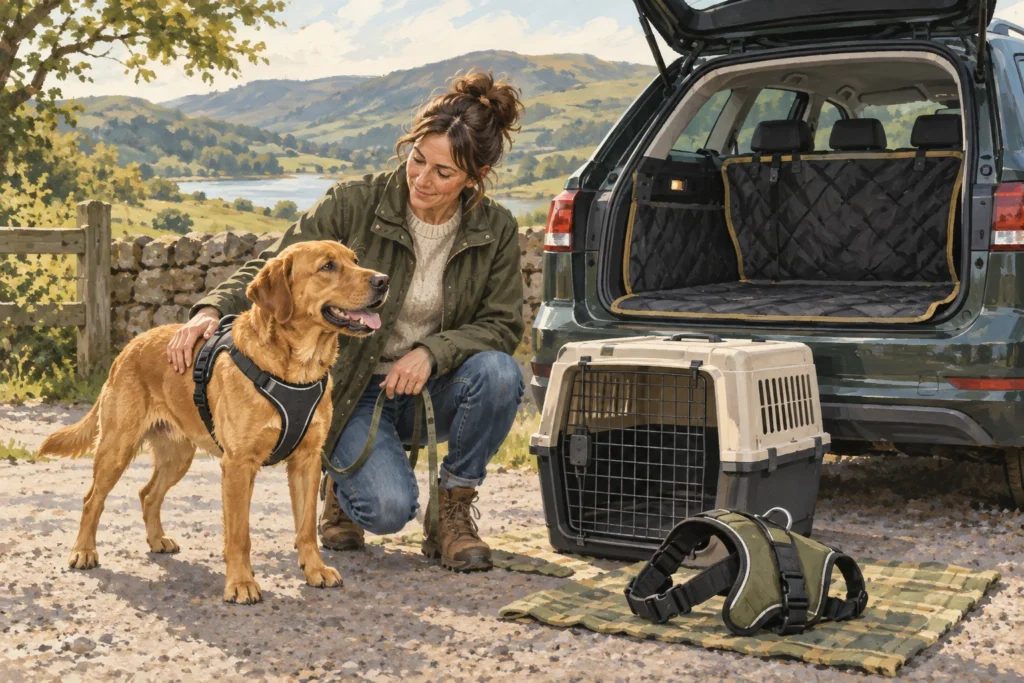
In the dog car crate vs harness decision, start with the space that can safely belong to your dog for the whole journey. A harness uses a suitable seat and belt arrangement. A secured transport crate provides a defined enclosure. A guard separates the boot from the passenger compartment. The best choice depends on the exact product and installation as well as the category.
Rule 57 of Great Britain’s Highway Code describes suitable restraint as a way to reduce distraction and the risk of injury during sudden stops. It names several possible types, but it does not make all products within those types equivalent.
Table of Contents
Compare what each approach actually does
| Approach | Space required | Reason to consider it | Main question before purchase |
|---|---|---|---|
| Car harness | Compatible seating position and belt | Boot remains available for secured luggage | Does the exact model fit the dog and have useful test evidence? |
| Transport crate | Suitable, ventilated vehicle space and fixing arrangement | Defined enclosure with its own door | Can it fit the dog and car while being installed as directed? |
| Dog guard | Compatible boot/passenger boundary | Keeps the passenger area separate without a complete crate | What does the barrier restrain, and what movement remains behind it? |
A harness works when the seat can stay available
A model intended for car restraint can be practical for a household whose boot is needed for a pushchair or equipment. It also makes sense when the dog already settles well on the rear seat. The seat, belt routing and harness need to work together; a seat cover is only upholstery protection.
Before ordering, sit in the parked car and rehearse the fastening steps without the dog. Can you reach the buckle without twisting awkwardly? Will a passenger regularly need that seat? Does the permitted setup allow the dog a comfortable position? An arrangement that must be improvised each trip invites errors.
This article contains Amazon affiliate links. As an Amazon Associate, we earn from qualifying purchases.
Sleepypod Clickit Range is an example of a dedicated car harness with manufacturer installation guidance and a model-specific certification route. Find Sleepypod Clickit Range harness on Amazon UK. Check the exact fit and instructions instead of adding a generic extension for convenience.
A crate needs two successful fits
The crate must accommodate the dog’s normal posture and also fit through the boot opening in the permitted position. A sloping rear window, wheel arch or tall loading lip can defeat an otherwise promising measurement. The RSPCA says a transport enclosure should allow a dog to stand, sit, turn and lie naturally.
Do not assume the wire crate used in the kitchen is suitable crash-protection equipment. Ask what vehicle use the maker permits, how the crate is secured and what evidence supports any crash claim. Our travel crate size guide covers the measurement process.
Crates also demand an access plan. Can you open the door without the dog stepping immediately into traffic? What happens if luggage shifts against it? Where will the crate live when the car is needed for something else?
A guard creates a boundary, not a fitted enclosure
Travall’s vehicle-specific guards illustrate this approach: the buyer selects a compatible vehicle fit, then follows that guard’s mounting instructions. The barrier sits between the boot and cabin. A guard does not automatically prevent every movement within the boot, and luggage sharing that space requires separate consideration.
Find Travall vehicle specific dog guard on Amazon UK. Add your vehicle’s make, model, body style and year when searching, then verify the exact compatibility listing. “Fits SUVs” is not precise enough for a vehicle-specific purchase.
For a small dog, inspect gaps and accessible edges as carefully as overall coverage. For a dog inclined to climb or push at barriers, seek a more appropriate setup rather than treating the guard as training. Keep ventilation and access to the dog in mind once the car is fully packed.
Make the decision with one real journey
- List the passengers and luggage. Use the busiest regular journey, not the empty-car ideal.
- Reserve the dog’s space. It should remain suitable after everything else is loaded.
- Shortlist a restraint type. Then investigate actual models and installation evidence.
- Plan entry and exit. Include a lead, doors, parking position and any appropriate mobility assistance.
- Practise calmly. Introduce the equipment before relying on it for a long journey.
If enclosure practice is needed, our crate training guide provides supporting preparation. None of these products makes leaving a dog in an unsuitable parked car safe, and none removes the need for breaks and attention to comfort.
Choose the arrangement you can explain in one sentence: where the dog sits, how the equipment is fixed, and what evidence supports that use. If one part is unclear, resolve it before buying the accessories.