
Last updated: 9 September 2026
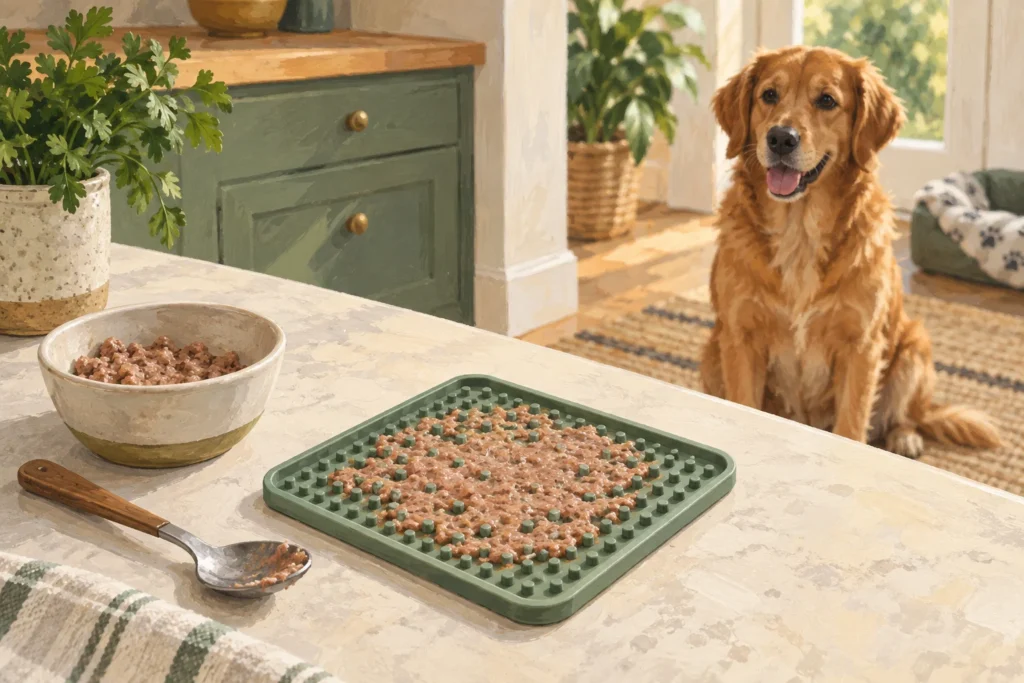
The simplest thing to put on a dog lick mat is a small measured portion of the dog’s usual suitable wet food. Spread it thinly so the first activity is easy. You do not need a collection of rich toppings or a different recipe every day to make the mat useful.
This article contains Amazon affiliate links. As an Amazon Associate, we earn from qualifying purchases.
Use foods that fit the dog’s normal feeding plan. If your dog has a prescribed diet, suspected food reaction or other dietary restriction, check with your vet before adding ingredients.
Table of Contents
Start with these preparation options
| Option | How to prepare it | Check first |
|---|---|---|
| Usual complete wet food | Spread a small measured portion across an easy area. | Opened-food storage and the remaining daily meal allowance. |
| Usual dry food, softened if permitted | Follow the food maker’s preparation advice, then mash to a manageable texture. | Whether soaking suits this food and how promptly it must be served. |
| A small amount of a familiar dog-safe treat paste | Use a thin smear, not a filled layer over the entire mat. | Ingredients, calories and feeding directions. |
| Plain cooked carrot, if already tolerated | Mash a small amount without added seasoning. | Individual dietary suitability; it is an extra, not a complete meal. |
Choose one option initially. If you introduce several new foods together and your dog develops digestive trouble, you have made it harder to identify what changed.
Measure before spreading
Put the food into a bowl on a scale, note the amount and then transfer it to the mat. It is easier to measure a portion this way than to estimate how much is hidden between raised patterns.
If the mat uses part of the normal meal, subtract that portion from what is served in the bowl. If it uses treats, include them with all other daily extras. A thin visual layer can still contain substantial energy when the topping is concentrated.
For illustration, a 15g topping at 400kcal per 100g contains 60kcal. That calculation is 15 × 400 ÷ 100. These are example figures, not a serving recommendation. Use the actual product’s energy information and your dog’s feeding plan.
Keep the first session easy
Cover only part of the mat and leave food accessible above the grooves. Place it on a stable clean surface, or attach a suction model exactly as directed. Watch whether the dog licks comfortably or starts biting, pawing frantically or moving the mat around.
Find LickiMat Tuff Buddy (red) on Amazon UK if a firm-backed flat design suits the task. A different texture may be easier for your dog, so begin with one product and a straightforward food preparation rather than buying a large set.
Stop if the dog tries to chew the mat. Do not make the food harder to reach in an attempt to discourage chewing, and do not leave a damaged mat available.
Peanut butter is optional
There is no need to use peanut butter, but if you do, check every ingredient and the energy content. Products containing xylitol must not be given to dogs. A familiar jar can change formulation, so check the current label rather than remembering last year’s ingredients.
Small amounts may still be inappropriate for an individual dietary plan. Avoid treating a product marketed for dogs as permission to ignore calories or medical restrictions. Ordinary wet food is often the simpler starting point.
Freezing is a separate decision
A mat labelled freezer-safe tells you about the mat, not the food. Follow the food manufacturer’s handling instructions, including any limits on refreezing previously thawed products. Butternut Box’s current guidance, for example, advises against refreezing its defrosted core meals at home, including in enrichment toys.
Freezing also makes the activity harder. Establish that the dog can use an unfrozen mat calmly before considering changes. You do not need to freeze a meal simply because other owners do so.
Finish with cleaning and observation
Remove leftovers and wash the mat after use according to its model instructions. Inspect deep corners and the underside, rinse and dry it. Keep prepared perishable food in the required storage and do not leave it sitting in a warm room for a later session.
Note what worked: the food, measured amount, texture and whether the dog stayed relaxed. That small record is more useful than collecting increasingly elaborate recipes. Our puzzle-toy guide can help you compare other activities if licking is not your dog’s preference.