
Last updated: 9 September 2026
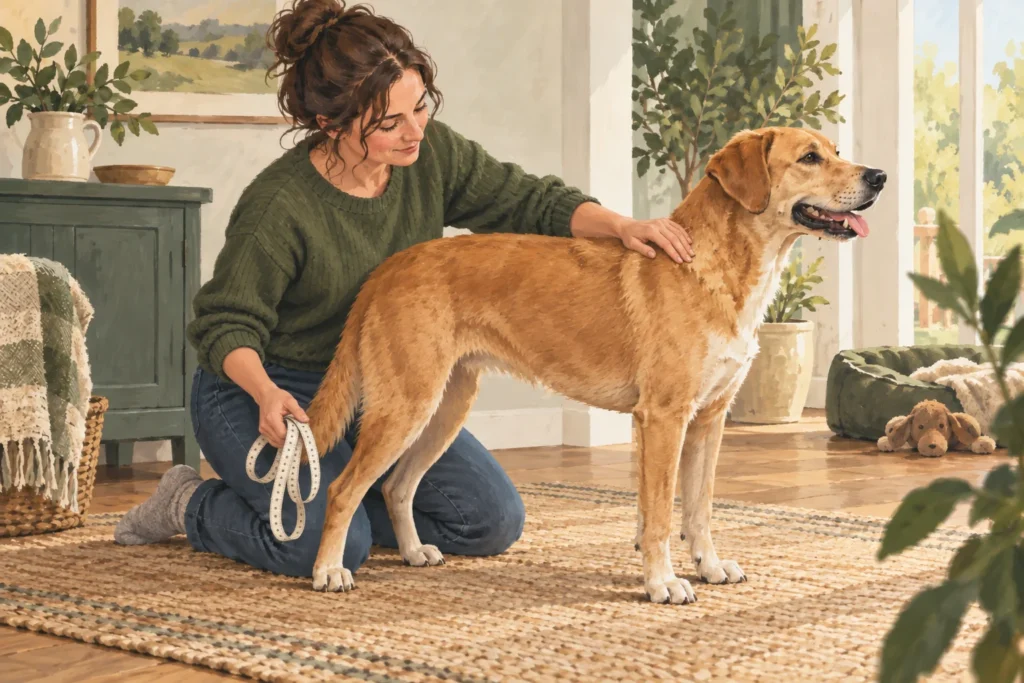
To measure your dog for a harness, use the measuring diagram for the exact model, with your dog standing naturally and a flexible tape lying flat. Record the required chest, neck or other measurements in the chart’s units. Then assess the fitted harness while the dog moves; measurements alone cannot confirm comfort or security.
This article contains Amazon affiliate links. As an Amazon Associate, we earn from qualifying purchases.
Do not start from the size of an old harness or a breed label. Brands use different proportions and measurement points, and even two models from one company can fit differently.
Table of Contents
Gather the right information first
Open the manufacturer’s product page, size chart and fitting instructions. Save the model name and version with your notes. For example, Ruffwear provides model-specific fitting resources, while PerfectFit selects a combination of modular pieces. These require different ordering decisions.
Find soft measuring tapes on Amazon UK if you do not have one. A rigid ruler is awkward around a curved chest. Keep the measuring tape away from the dog’s mouth and put it away as soon as you have recorded the figures.
Measure without changing the dog’s posture
- Choose a calm moment on a stable, non-slip surface.
- Let the dog stand normally rather than stretching them into a pose.
- Locate the measuring point shown on the selected model’s diagram.
- Keep the tape flat and untwisted, following the brand’s tension guidance.
- Read and record the measurement in centimetres or inches as requested.
- Repeat once to check that the first reading was consistent.
Do not assume a collar measurement is the harness’s neck measurement. A harness may sit lower or use a different route around the front of the body. Likewise, “behind the front legs” should be interpreted through the maker’s diagram rather than guessed at an arbitrary distance.
Use a simple record
| Record | What to write |
|---|---|
| Dog and date | Name, age if growing, and measurement date. |
| Product | Brand, model and version. |
| Required measurements | Each measurement with its unit and diagram position. |
| Chart recommendation | Size or combination of pieces. |
| Uncertainty | Borderline reading, unusual proportions or previous rubbing. |
If the measurements straddle two sizes, follow the manufacturer’s advice or ask its fitting team. Do not automatically size up for comfort or size down for security. Either choice can create a different fitting problem.
Adjust the harness before the first walk
Introduce the harness calmly, allowing the dog to investigate without chasing them with it. Fasten it according to the instructions and adjust each intended point. Check that straps lie flat and buckles are fully closed.
Use the maker’s guidance on snugness. A general finger test can be a rough check, but fingers differ in size and a harness’s position matters as much as the gap under one strap. Avoid treating a single measurement as proof of a complete fit.
PerfectFit’s top, front and girth pieces can be selected separately to address proportions. If one section is wrong, confirm the appropriate component rather than loosening every other section to compensate.
Watch movement in a secure space
Let the dog walk, turn, sit and lower their head while you observe from the front and side. Look for twisting, slipping, bunching or contact that appears uncomfortable. Recheck whether adjustments hold after movement.
Photographs taken from several angles can help a manufacturer’s fitting service, but photographs alone cannot show every pressure or movement issue. If your dog has previously escaped from equipment, seek qualified help with a secure fitting assessment rather than testing the harness on an exposed route.
Our harness and collar comparison gives related background. If pulling is the concern, see the pulling-harness guide alongside a reward-based training plan.
Recheck as circumstances change
Puppies grow, coats change and adult dogs can gain or lose weight. Repeat the fit check after those changes, after washing or adjustment, and whenever you notice slipping or discomfort. Record the date instead of relying on memory.
If the dog suddenly resists equipment that previously caused no difficulty, look for an explanation and obtain veterinary advice if pain or skin trouble is possible. Buying a larger harness without investigating may leave the underlying issue unresolved.
The successful order is the one that matches the current dog, the exact model chart and a comfortable moving fit. Keep the instructions and model details so later replacements are easier to compare.