
Last updated: 9 September 2026
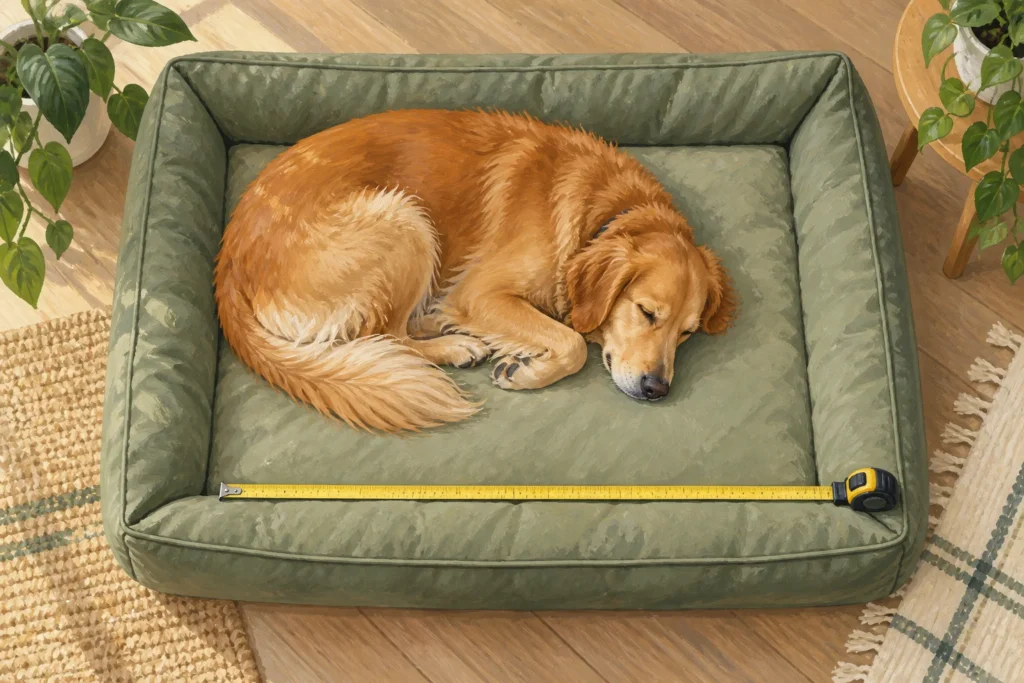
The right dog-bed size is one that accommodates your dog’s comfortable sleeping positions within the usable sleeping area. Measure the dog at rest, then compare those measurements with the bed’s interior. Small, medium and large are retailer labels, so they cannot reliably be carried from one brand to another.
This article contains Amazon affiliate links. As an Amazon Associate, we earn from qualifying purchases.
Weight and breed can help narrow a search, but neither tells you how your individual dog likes to lie. A dog that curls up in the morning may stretch out fully later in the day.
Table of Contents
Observe before measuring
Watch several ordinary resting periods without repositioning the dog. Note whether they lie on their side, curl tightly, stretch their forelegs or rest their head on an edge. Look at the position taking up the most comfortable space, not just the neatest pose.
Measure the occupied length and width while the dog is relaxed, without bringing the tape close enough to disturb them. Another option is to mark the area after they have moved away and measure that space. Use a familiar resting surface so the exercise does not become a new training task.
Find soft measuring tapes on Amazon UK if you need a flexible measure. Keep it under adult control and put it away immediately; a measuring tape is a tool for the person, not something for the dog to investigate by chewing.
Separate three measurements
| Measurement | What it tells you | What it does not tell you |
|---|---|---|
| Overall bed dimensions | The floor space occupied. | How much room remains inside thick sides. |
| Usable sleeping area | The interior available to the dog’s body. | Whether the entrance and filling suit the dog. |
| Entry or mattress height | The step needed to access the resting surface. | Whether the base stays stable under movement. |
Manufacturers sometimes publish these separately. Ferplast’s Siesta Deluxe page, for example, distinguishes overall product measurements from useful internal dimensions. That is the kind of information to seek when a hard shell or pronounced side occupies part of the advertised footprint.
Use an actual comparison
Imagine your dog occupies 68cm by 42cm in a favourite stretched position. Bed A has outer dimensions of 80cm by 60cm but an interior of 60cm by 40cm. Bed B has a stated usable area of 76cm by 50cm. On those measurements, B better accommodates that observed position, even if both are labelled medium.
Those figures are illustrative. Do not use them as a fixed allowance for every dog, and do not add an arbitrary number of centimetres to a breed chart without checking the result. The practical question is whether your dog’s natural position fits without requiring them to fold around the bed.
If a listing supplies only outer dimensions, ask for the interior or choose one with clearer information. Estimating thick bolsters from a promotional photograph can lead to a poor purchase.
Check shape as well as area
An oval bed and a rectangular mattress can have the same maximum length and width but different corner space. A dog sleeping diagonally may use a rectangular mat differently from a round nest. Compare the outline of the usable surface with the shape the dog occupies.
Draw the proposed dimensions using removable floor markers. For a bolster bed, mark the inner boundary too. This also shows whether the outer bed blocks a doorway, radiator access or a normal route through the room.
Consider growth and access
For a puppy, expect to recheck measurements during growth. A generously sized simple bed may remain useful, but ensure loose bedding or excess material does not invite chewing and swallowing. Replace damaged bedding promptly.
For a dog that struggles to step over sides or rise from a deep cushion, size alone is not the entire decision. Ask your vet about a suitable resting setup. A sufficiently long bed can still be unsuitable because of access or stability.
Our memory-foam bed guide discusses related construction choices. Use product claims as questions to investigate, not a substitute for checking your dog’s comfort.
Keep a shopping note
- Largest observed resting length and width.
- Whether a headrest or open stretch space is used.
- Maximum outer footprint available in the room.
- Comfortable entrance arrangement.
- Washing-machine and drying-space limitations.
Take that note to each listing. Once the bed arrives, confirm measurements before use and retain packaging until you know it matches the description. Then watch whether the dog can change position and rest naturally. Their use of the bed provides more useful feedback than the size word on its label.